 The Council of Trent may have been in part brought about in
response to Martin Luther. Yet actions of the Catholic Reformation were in
progress before Luther was even conceived as a threat to the Catholic Church.
This can be seen as starting under Pope Alexander. Though under pope Alexander during
the renaissance a reform group was conceived it had little to no observable
effect on any of the issues plaguing the church at the time. Yet the reform
process was expedited by Luther’s criticism of the Catholic church although
many loyal Catholics did agree with Martin Luther that there were issues that
needed to be fixed within the church. These loyal followers instead brought
about the Council of Trent to solve the issues that they saw needed
clarification. Also the Council of Trent condemned the protestant movement.
The Council of Trent may have been in part brought about in
response to Martin Luther. Yet actions of the Catholic Reformation were in
progress before Luther was even conceived as a threat to the Catholic Church.
This can be seen as starting under Pope Alexander. Though under pope Alexander during
the renaissance a reform group was conceived it had little to no observable
effect on any of the issues plaguing the church at the time. Yet the reform
process was expedited by Luther’s criticism of the Catholic church although
many loyal Catholics did agree with Martin Luther that there were issues that
needed to be fixed within the church. These loyal followers instead brought
about the Council of Trent to solve the issues that they saw needed
clarification. Also the Council of Trent condemned the protestant movement. Friday, May 6, 2016
Which Came First??
The Council of Trent may have been in part brought about in
response to Martin Luther. Yet actions of the Catholic Reformation were in
progress before Luther was even conceived as a threat to the Catholic Church.
This can be seen as starting under Pope Alexander. Though under pope Alexander during
the renaissance a reform group was conceived it had little to no observable
effect on any of the issues plaguing the church at the time. Yet the reform
process was expedited by Luther’s criticism of the Catholic church although
many loyal Catholics did agree with Martin Luther that there were issues that
needed to be fixed within the church. These loyal followers instead brought
about the Council of Trent to solve the issues that they saw needed
clarification. Also the Council of Trent condemned the protestant movement. 
Happy Massacre Day!
St.Bartholomew's day massacre was killing spree in Paris, France after King Charles IX of France ordered an assassination on the Huguenot Protestant leader the Duke of Guise in Paris. King Charles was very influenced by his mother Catherine de Medici who just so happened to have ordered the assassination of a huguenot leader just two days before King Charles ordered an assassination. This mommas boy listens to everything she says. She told Charles that the Huguenots were planning a rebellion against him and obviously he doesn't want that to happen so he ordered the assassination of their leaders. This obviously did not sit well with the Huguenots. Soon after the massacre began.
The following piece by François Dubois depicts a proclaimed eye witness experience of this massacre. As shown in the painting, there is utter chaos through the streets of Paris as thousands are being killed. According to different factions during the time period anywhere from 3,000-70,000 people were killed during the St.Bartholomew's Day Massacre. This massacre ended about 10 years after the Duke was assassinated.
http://www.britannica.com/event/Massacre-of-Saint-Bartholomews-Day
http://www.history.com/this-day-in-history/saint-bartholomews-day-massacre
The following piece by François Dubois depicts a proclaimed eye witness experience of this massacre. As shown in the painting, there is utter chaos through the streets of Paris as thousands are being killed. According to different factions during the time period anywhere from 3,000-70,000 people were killed during the St.Bartholomew's Day Massacre. This massacre ended about 10 years after the Duke was assassinated.
http://www.britannica.com/event/Massacre-of-Saint-Bartholomews-Day
http://www.history.com/this-day-in-history/saint-bartholomews-day-massacre
The Spanish Armada
The year was 1588 and the war was over England. The Spanish Armada was a Spanish fleet of 130 ships with a strategic aim to overthrow Queen Elizabeth I of England and the establishment of Protestantism in England. The fleet was tasked with the purpose of escorting an army to invade the English mainland. If they succeeded the course of English history would have taken a drastically different path.
 The descent of the Armada came at a pivotal time of change in sea warfare. The Spanish represented the old tradition while the English fought with new design and tactics. In the old model, war was fought on sea as if on land, with soldiers discharging arrows and handguns, boarding the enemy ships and engaging in hand fighting for battle wins. The Spanish ships, or galleons, were made for this type of fighting. They were impressive in size and rode high out of the water with towering masts, but their height and broad nature made them awkward to sail and maneuver.
English captains inspired a new form of ship which was made to be lower in the water, with a long prow and much reduced masts. These sleek ships carried more sophisticated forms of rigging, enabling them to sail closer to the wind, thus making them more maneuverable and faster than the Spanish galleons. The English navy relied on gunnery, rather than boarding, to defeat an enemy. The design of the ships allowed the English to close in and fire repeatedly on the sides of the Spanish ships at short range, inflicting considerable damage and sinking ships. The Armada did not have a way to counter with gunfire-centered attack as Spanish crews were not trained to load and fire repeatedly during a battle and their guns were not designed for rapid fire.
Credits:
http://www.britishbattles.com/spanish-war/spanish-armada.htm
https://en.wikipedia.org/wiki/Spanish_Armada
Images:
http://www.britishbattles.com/spanish-war/spanish-armada.htm

English captains inspired a new form of ship which was made to be lower in the water, with a long prow and much reduced masts. These sleek ships carried more sophisticated forms of rigging, enabling them to sail closer to the wind, thus making them more maneuverable and faster than the Spanish galleons. The English navy relied on gunnery, rather than boarding, to defeat an enemy. The design of the ships allowed the English to close in and fire repeatedly on the sides of the Spanish ships at short range, inflicting considerable damage and sinking ships. The Armada did not have a way to counter with gunfire-centered attack as Spanish crews were not trained to load and fire repeatedly during a battle and their guns were not designed for rapid fire.
Credits:
http://www.britishbattles.com/spanish-war/spanish-armada.htm
https://en.wikipedia.org/wiki/Spanish_Armada
Images:
http://www.britishbattles.com/spanish-war/spanish-armada.htm
Thursday, May 5, 2016
The Four Witches or the Three Graces plus a Fourth
 The Four Witches is an engraving by Albrecht Durer, dating to 1497. The work shows four sensual, nude women gathered in a circle. The women almost look like they are conspiring to do evil deeds together as seen by their expressions and indicated by the bones scattered. The doorway, to the right, is likely a gateway to death as seen by the bones lying across it. The doorway to the left seems to show the Devil, or a monster, engulfed in flames and might be intended as a gateway to hell. The intended meaning of the woodcut is unclear; possible interpretations range from the Three Fates with Discord, to Aphrodite and the Three Graces, or four witches, or four girls in a bath house. The engraving could also depict the Greek goddess Hecate, goddess of the crossroads and patroness of magic, witchcraft, necromancy, and sorcery and her counterpart, Diana. The goddess was often depicted with three faces, suggesting that she could look in all directions. Whatever the subject, the woodcut showcases the fears of witchcraft and paganism in the newly formed Protestant world.
Credits:
http://risdmuseum.org/art_design/objects/342_the_four_witches
http://www.wga.hu/html_m/d/durer/2/13/1/019.html
https://en.wikipedia.org/wiki/The_Four_Witches
Images:
https://en.wikipedia.org/wiki/The_Four_Witches
Judensau: Anti-semitism in the Reformation
A
 Judensau is a folk art image of Jews in obscene contact with a large sow, which is seen as an unclean animal in the Jewish religion, that appeared during the 13th century, mainly in Germany. The arrangement of Jews surrounding, suckling, and having intercourse with the animal is a blatant example of antisemitic propaganda during the Reformation. The earliest appearance of the Judensau dates to about 1210 on the underside of a choir-stall seat in 1210. Images appear mostly in carvings and sculptures on church walls where they were likely to be seen by many. With the advent of the printing press, the image started to appear more frequently in woodcut form, accompanying many antisemitic commentary in pamphlets. The facade of the Stadtkirche, in Wittenberg, contains a Judensau, from 1305. The sculpture portrays Jews drinking from a sow's teats, as the rabbi looks under its tail and remains one of the last remaining examples of "medieval Jew baiting" in Germany.

Credits:
Images:

Malleus Maleficarum

The Malleus Maleficarum, or Hammer of the Witches, is a pamphlet on the prosecution of witches, written by a German Catholic clergyman, Heinrich Kramer, in 1487. A short three years after its publication, the Catholic Church condemned the treatise in 1490; although, it was still used by royal courts and contributed to the increasingly brutal prosecution of witchcraft in the 16th century, coming at the end of the Reformation. According to the Malleus Maleficarum, there are three elements to witchcraft: the evil intentions of the witch, help from the Devil, and the permission of God.
The treatise is divided into three sections. The first aimed at clergy and refutes critics who deny the existence of witchcraft. The section examines the concept of witchcraft theoretically by addressing the question of whether witchcraft is real or imaginary. The second lays the foundation by describing forms of witchcraft and remedies for it. Matters of practice, the powers of witches, and their recruitment strategies were discussed. It details how witches cast spells and tells how to help those affected by witchcraft. The third section is the legal part of the pamphlet. It offers a step-by-step guide to the conduct of a trail and the formal charging.
Credits:
https://en.wikipedia.org/wiki/Malleus_Maleficarum
http://www.malleusmaleficarum.org
Images:
http://www.malleusmaleficarum.org/WordPress/wp-content/uploads/2012/08/MalleusLatin2.jpg

The Three Graces

This painting, called the The Three Graces,was made by Raphael in 1506, and was a probably a panel in diptych given to Scipione di Tommaso Borghese. The first panel has Scipio, the sleeping knight, choose between Venus, who represents pleasure, and Minerva, who represents Virtue; this panel has three graces rewarding his choice, virtue, with the Golden Apples of the Hesperides. The painting is composed with a sense of harmony and balance. The three graces personify grace and beauty, and are the handmaidens of goddesses, usually Venus. What each of the three graces represent has been disputed; some say its the giving, receiving, and returning of gifts, while others saw them as three phases of love: beauty, arousing desire, leading to fulfillment, and others say they symbolize Chastity, Beauty, and Love. The Three Graces are in their classical pose, seen throughout centuries of painting, with two facing the audience while one is turned away. This painting was the first to display the a female's nude front and back. It was based on a classical sculpture of the Three Graces found in Siena.
Sources:
Wednesday, May 4, 2016
Codpiece: Does Size Matter?
 When someone thinks of King Henry the VIII of England,
typically the initial thought is about his six wives and the split with the
Catholic Church. Yet this one of kind king also had a one of kind codpiece. This
interesting piece of fashion was initially designed for modesty to ensure that
the male genitals would remain covered no matter what the man was wearing or
doing. Eventually this innocent and modest piece of garment quickly became a
fashion statement that quickly became essential for everybody who wanted to be
somebody. Yet King Henry VII took this to a whole new level as his codpiece
grew in size over his lifetime to prove its that this piece of garment met a
kingly level. Eventually Henry VII had padded his codpiece so much that it was
an unbelievable size; even for a king. Also due to the large size of some codpieces that people would hide valuables and even possibly weapons in them. So in-essence this became a multi-purpose piece of fashion, that also offered battlefield protection to ensure the Henry VII could have his baby boy. Unfortunately, though this fashion died
out in England after Queen Elizabeth I came to power as she has no need for such gaudy fashion.
When someone thinks of King Henry the VIII of England,
typically the initial thought is about his six wives and the split with the
Catholic Church. Yet this one of kind king also had a one of kind codpiece. This
interesting piece of fashion was initially designed for modesty to ensure that
the male genitals would remain covered no matter what the man was wearing or
doing. Eventually this innocent and modest piece of garment quickly became a
fashion statement that quickly became essential for everybody who wanted to be
somebody. Yet King Henry VII took this to a whole new level as his codpiece
grew in size over his lifetime to prove its that this piece of garment met a
kingly level. Eventually Henry VII had padded his codpiece so much that it was
an unbelievable size; even for a king. Also due to the large size of some codpieces that people would hide valuables and even possibly weapons in them. So in-essence this became a multi-purpose piece of fashion, that also offered battlefield protection to ensure the Henry VII could have his baby boy. Unfortunately, though this fashion died
out in England after Queen Elizabeth I came to power as she has no need for such gaudy fashion.http://www.fashionencyclopedia.com/fashion_costume_culture/European-Culture-16th-Century/Codpiece.html
A Witch's Burning Secret
During the reformation and post reformation, claims of witches living amongst the people of Europe became very frequent. Accusations that certain people, mostly women, were witches and housed the devil himself within them. In 1515 outbreaks of witch hysteria rained over Geneva, Switzerland as they accused and burned over 500 people at the stake. Just nine years later in Como, Italy, another 1000 people were executed under accusations of witchcraft. The only thing necessary for an execution of a "witch" was someone simply saying "He/She is a witch!" and they were then taken to trial. During these "trials" a witch would be found guilty of witchcraft with practically no way of escaping the accusation. Since witches house the devil they are known to lie. In this case anything they say is a lie unless they admit to being a witch of course. Even in this scenario they will be found guilty and executed. All of this chaos stems off of paranoia of the catholic church and the protestants.
The following piece is called 'The Examination of a Witch' by Matteson. Although this painting is from 1853 it holds the same value of those during the European witch trials. In the painting, the woman is being deemed a witch due to body markings that the town has seen. In this the presumed judge is examining these markings as others in the scene are fainting because of the disbelief that they are in the presence of a "witch". The woman's expression is that of a person who knows their fate. Being executed in a way only fit for a witch.
 http://www.wsc.mass.edu/mhj/pdfs/TEACHING%20RESOURCES%20Teaching%20the%20Salem%20Witch%20Trials.pdf
http://law2.umkc.edu/faculty/projects/ftrials/salem/witchhistory.html
The following piece is called 'The Examination of a Witch' by Matteson. Although this painting is from 1853 it holds the same value of those during the European witch trials. In the painting, the woman is being deemed a witch due to body markings that the town has seen. In this the presumed judge is examining these markings as others in the scene are fainting because of the disbelief that they are in the presence of a "witch". The woman's expression is that of a person who knows their fate. Being executed in a way only fit for a witch.
http://www.wsc.mass.edu/mhj/pdfs/TEACHING%20RESOURCES%20Teaching%20the%20Salem%20Witch%20Trials.pdfhttp://law2.umkc.edu/faculty/projects/ftrials/salem/witchhistory.html
Three Decades of Divinity
The thirty years war began in 1618 and lasted until 1648. This war began with the holy Roman Empire attempting to "curtail certain religious privileges enjoyed by his subjects".. This sparked an uprising among the protestantsThe protestants then turned to some of the most powerful and well known protestant states in Great Britain, Denmark, and the Dutch Republic. In order to counter them other forces were brought into the picture such as the German catholics, Spain, and the papacy by the Roman Empire. After thirty years of fighting and many lives lost, the war ended at the Battle of Prague in 1648.
Through this long time span, life did not seize, and since life did not seize, art continued to be made. There were many pieces created regarding the war as it was a very volatile time period. A piece called 'Rocroi, the last tercio' by Augusto Ferrer Dalmau depicted as seen by many as the turning point of this war as it showed that the perceived invincibility of the Spanish was false. The Spanish army was slaughtered by the French. In this piece, it is shown that many of the Spanish lay dead in front of a large amount of French soldiers realigning. Dalmau does not leave any room for imagination as he made this piece very graphic in many manors from dead horses, dead men, and how could one leave pools of blood from the image. A statement is made from this piece giving the viewer no choice but to know who won this battle.
http://www.history.com/topics/thirty-years-war

Monday, May 2, 2016
The Lion of the North
 King Gustav II Adolf of Sweden was
one of the most power people in Europe at the time of the Thirty Years War. He led
Sweden which up until this time had been seen as a lesser power. Under his
leadership Sweden became the most powerful protestant state and would prevent
the destruction of the Protestant League during the 30 Years War. Swedish involvement
in this critical religious war that also led to dissolution what was left the
Holy Roman Empire was a pivotal moment that completely changed the momentum of
the war. Yet Gustav’s impact and progress, as a commander on the battlefield with no equals, during the war would find itself-undone
when the King of Sweden was slain on the field of battle in Leipzig. The protestants
would hold on and survive the war to negotiate the peace of Westphalia in 1648.
Peace between the different denominations of Christianity would largely remain as
both sides no turned to witch hunts to satisfy their taste for blood.
King Gustav II Adolf of Sweden was
one of the most power people in Europe at the time of the Thirty Years War. He led
Sweden which up until this time had been seen as a lesser power. Under his
leadership Sweden became the most powerful protestant state and would prevent
the destruction of the Protestant League during the 30 Years War. Swedish involvement
in this critical religious war that also led to dissolution what was left the
Holy Roman Empire was a pivotal moment that completely changed the momentum of
the war. Yet Gustav’s impact and progress, as a commander on the battlefield with no equals, during the war would find itself-undone
when the King of Sweden was slain on the field of battle in Leipzig. The protestants
would hold on and survive the war to negotiate the peace of Westphalia in 1648.
Peace between the different denominations of Christianity would largely remain as
both sides no turned to witch hunts to satisfy their taste for blood.Reformation & Religious Tolerance?
Upon reading the New
York Times review of Benjamin Kaplan’s book, Divided by Faith, I
gravitate towards the description that “Kaplan maintains that religious toleration
declined from around 1550 to 1750.” (Steinfels). This argument for the decrease
in religious tolerance during the period appears supported by events of the
period, like, for example, the pockets of witch-hunting. Clearly, the
Reformation did not necessarily promote open acceptance of all different reform
movements that sprung from the period, if it did offer a Protestant alternative
to the Catholic Church. One example of decreased religious toleration manifests
in the experiences of the Anabaptists of the period, who were “arrested, burned
at the stake, and sometimes symbolically punished by drowning” (Zophy 207).
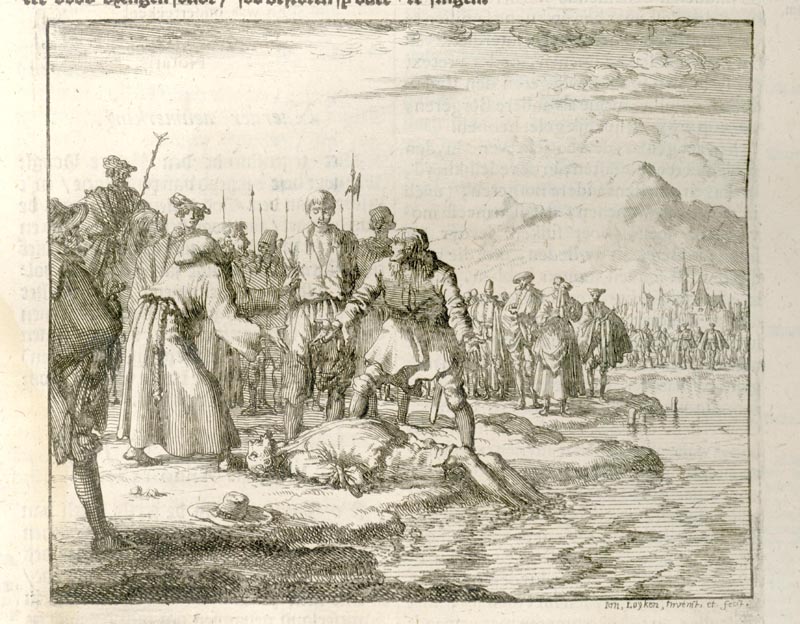
Here, I utilize a
woodcut to illustrate the persecution of the Anabaptists. Granted, this
particular woodcut comes from “Martyrs Mirror,” a seventeenth-century
collection of illustrations by Jan Luyken. Therefore, the art piece is subject to
the influence of historical hindsight/revision itself. The specific engraving I
chose depicts the drowning of Heinrich Summer and Jakob Mandel in 1582, both of
whom were Anabaptists. The illustration naturally draws focus to the anguish of
the man who has been subjected to the drowning. The figure above him actually
seems to be questioning/displaying anger over the death, hands spread out in a
gesture motioning to the plight of the man (Summer or Mandel presumably).
Accurately, there are many onlookers- persecution during the Reformation period
was intended to be public. The castle in the background and a sort of
antiquated feel to the portrait (even for the 1500s) may hint at the feudal
system that organized society primarily in the medieval period. In this way,
the artist seems to separate his time period from even that of just a century
previous. In general, the woodcut demonstrates the ways in which the
Reformation was as much a challenge of older structures of religion/society as
it was a reinforcement of order/religion/power structures in an intense or
instigative manner.
Sources:
Steinfels, Peter. "A Revisionist Historian Looks at Religious Toleration." New York Times, Nov. 24, 2007. Print.
On the artist- http://www.geheugenvannederland.nl/?/en/collecties/jan_en_casper_luyken/jan_luyken
On the Martyrs Mirror- https://kauffman.bethelks.edu/martyrs/creation.html
Image- https://mla.bethelks.edu/holdings/scans/martyrsmirror/
He's Out for the Count- "The Bewitched Groom"
As we have studied, the
Reformation occurred contemporaneously with some major pockets of witch-hunting
in German regions and elsewhere. The atmosphere of religious fervor, growing bureaucracy,
and the religious upheavals/resulting societal expectations contributed to the appearance
of witch-hunts. However, there were many factors involved and I chose this
particular woodcut to examine the witch-hunts in relation to the influence of
the Reformation. Entitled “The Bewitched Groom,” this woodcut was produced by Hans
Baldung Grien in 1544.
Although not
necessarily focused on witches, the woodcut is telling in a number of ways. For
one, the witch-like figure leaning in by the windowsill appears old and is
waving a sort of broom or possibly plant stalk in a violent manner. Secondly,
the male figure is drawn at such an angle as to emphasize male sexuality, even
as he has been rendered unconscious or at the least, knocked down. Importantly,
his tools lay loosely by him, un-useful in his bewitched state. Moreover, the
horse stands with his rear towards the main figure, which suggests the inverted
or unnaturalness of the scene overall. Reformation ideals called for the man to
be the powerful and moral leader of the house, while women were expected to be
obedient wives and mothers. This woodcut displays the fear of non-conformity to
such order. As described, the woman’s age, appearance, and action make her
unsuitable for female domesticity. The male is bewitched and again, not able to
carry out his duties. Overall, this demonstrates how the Reformation, rather
than a free flow of religious debate, became a rigid sort of structuring
mechanism for society, in which notions of gender influenced the occurrence of
witch-hunts.

For a clearer image/info- http://www.metmuseum.org/art/collection/search/336238
Thursday, April 28, 2016
The Power of a Portrait
 Queen Elizabeth I is widely regarded as one of England's greatest monarchs. One of her many strengths was an understanding of the importance of public image. Her portraits were carefully crafted and included symbols to convey power and majesty. The Rainbow Portrait, painted in 1600 by Isaac Oliver, exemplifies the use of images to illustrate the Queen's good qualities. The cloak that Elizabeth is wearing in the portrait is embroidered with eyes and ears, signifying that she can hear and see everything. Her intricate headdress is decorated with pearls and rubies, and holds up her royal crown. The pearls are meant to represent her virginity, while the crown illustrates her royal status. On her left sleeve is a jeweled serpent with heart-shaped ruby in its mouth; the snake symbolizes wisdom and the ruby represents the Queen's heart. The snake has caught the heart, meaning that the Queen's wisdom restrains her emotions. Above the snake is a celestial sphere, which also signifies wisdom and the Queen's power over nature. Elizabeth holds a rainbow in her right hand with the latin phrase 'Non sine sole iris' (No rainbow without the sun) inscribed above. The rainbow represents peace and prosperity, while the inscription tells the audience that the Queen and her wisdom brings the peace and prosperity. Though Elizabeth was actually in her sixties when this portrait was painted, she is depicted as young and beautiful. This portrait was carefully thought out to present a wise and powerful monarch.
Sources:
http://www.marileecody.com/eliz1-images.html
Huguenots: Where are They Now
 French Huguenots were a part of the reformed reformation process and mainly located in within France. The Huguenots like the
Cathars, who preceded them, had to fight for their beliefs against the French Catholics . Yet unlike the Cathars
the French Huguenots successfully defended their faith and were not exterminated.
Under the edict of Nantes the Huguenots were protected until it was repealed in
1685. The result would be a massive diaspora of hundreds of thousands French citizens to more
accepting protestant nations such as Great Britain and Germanic Countries.
Great Britain which allowed much more religious freedom in her colonies is probably
why so many Huguenots who retain their denominations traditions are currently
residing in Australia. Though their numbers are vastly smaller than at their height
which was around 2 million French believers. Though many assimilated to the cultures
of the countries they fled to. While not all Huguenots fled France and a couple
Huguenot communities remain in southern France. As in 1787 protestants such as the Huguenots finally were accepted and considered equal citizens under law. Also there is a Huguenot society in America that accepts applicants who can prove Huguenot heritage or is sponsored by a current member.
French Huguenots were a part of the reformed reformation process and mainly located in within France. The Huguenots like the
Cathars, who preceded them, had to fight for their beliefs against the French Catholics . Yet unlike the Cathars
the French Huguenots successfully defended their faith and were not exterminated.
Under the edict of Nantes the Huguenots were protected until it was repealed in
1685. The result would be a massive diaspora of hundreds of thousands French citizens to more
accepting protestant nations such as Great Britain and Germanic Countries.
Great Britain which allowed much more religious freedom in her colonies is probably
why so many Huguenots who retain their denominations traditions are currently
residing in Australia. Though their numbers are vastly smaller than at their height
which was around 2 million French believers. Though many assimilated to the cultures
of the countries they fled to. While not all Huguenots fled France and a couple
Huguenot communities remain in southern France. As in 1787 protestants such as the Huguenots finally were accepted and considered equal citizens under law. Also there is a Huguenot society in America that accepts applicants who can prove Huguenot heritage or is sponsored by a current member. Monday, April 25, 2016
It's in the eyes- Artwork of St. Teresa of Avila
In accordance with our
study of the Counter Reformation, I will look at another figure of the period –
St. Teresa of Avila – through the lens of two different works of art. Teresa of
Avila (1515-1582) is best known for her mysticism, writings, and leadership in
the Carmelite order in Spain. During her
lifetime, she remained persistent in the growth of a reform-minded Carmelite
order, as well as wrote works such as Way of Perfection and her Autobiography
(Zophy 261-262). I desired to compare two works focused on St. Teresa of
Avila in order to demonstrate both her own legacy and that of the Counter
Reformation.
The first work is
Bernini’s infamous sculpture, The Ecstasy of St. Teresa. Sculpted in the
years 1647-1652, the work stands as a testimony to Teresa of Avila’s distinct
mysticism, as it depicts her in the midst of a religious vision. As the viewer
can see, the sculpture retains all the drama of the Baroque period whilst
rendering the saint as overwhelmingly beholden to her spiritual vision.
Moreover, the facial expressions of both Teresa and the other figure evoke
emotion and vivid experience. The multiple folds of Teresa’s garb add further
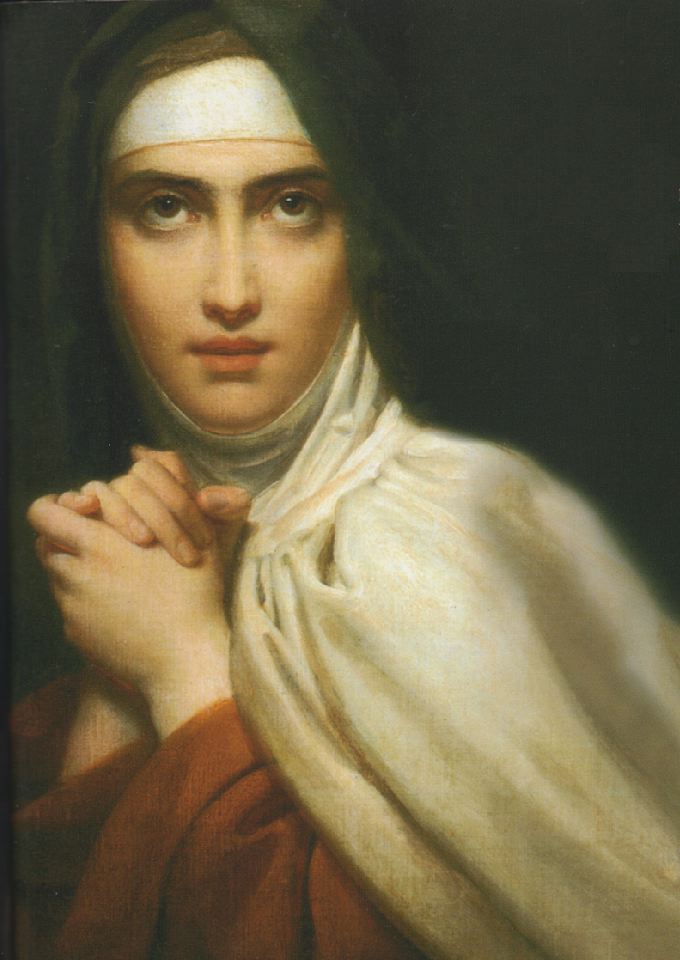
spectacle to the scene. In comparison, the second work, Baron Francois Gerard’s
St. Teresa, is altogether different, but this naturally stems from its
later time frame (early 19th century) and thus, Romantic style. The
portrait simply gives a modest Teresa, with eyes that angled upward convey a
subtle link to mysticism, but moreover, convey a blend of piety and mystery.
Gerard gives an ideal Teresa, quiet but impactful in beauty and mystery, a
spiritual figure from a faraway, lost place (hence approximately two centuries
in separation between the portrait and her death). Bernini equally moves away from reality, but
in a way that still seems evocative of the mysticism central to St. Teresa’s character
and even the criticism she faced. The works are in truth mostly contrasting
depictions of St. Teresa, but they both persist in demonstrating the historical
impact of reformers from the period, who tend to appear as stabilizers not defectors
after their lifetimes.

Sources:
http://www.metmuseum.org/toah/hd/bern/hd_bern.htm
http://www.wga.hu/html_m/g/gerard/7theresa.html
Images:
http://www.artble.com/imgs/d/a/5/431705/the_ecstasy_of_saint_theresa.jpg
https://fraangelicoinstitute.com/2012/10/15/st-teresa-of-avila-on-love/teresa_avila_gerard/
The Mary Rose: Henry's Baby
The Mary Rose was a carrack-type warship that came to be known as the best ship of Henry VIII's time. She was known for her grandeur, beauty, and success. Succeeding Henry's coronation, the new young King knew he needed a great navy, as England was threatened by both the Scots and the French. At the time, he only had a handful of warships and merchant vessels at his disposal. Therefore, in 1510, construction of the Mary Rose started in Portsmouth, where 600 oak trees were used to build it. The earliest reference of the Mary Rose by name appears in a payment record made by Henri VIII for bringing the ship from Portsmouth to the River Thames.
The ship's first battle was in 1512 against the French fleet. The ship's captain deemed it "the noblest ship of sail". The Mary Rose fought three battles against the French, before sinking on July 19, 1545 at the Battle of Solent. Many attempts were made between 1545 and 1549 to raise to wreck, all unsuccessful.
After lying dormant for 300 years, divers John and Charles Deane discovered the wreck and were able to raise guns. However, they eventually lost the site of the wreck. In 1982, the wreck of the hull was raised, and event that was viewed on television by 60 million people worldwide.

It is believed that the Mary Rose was named after Henry's sister. However, it was most likely named after the Virgin Mary.


Visitors can now visit the ship in Portsmouth- (The Mary Rose Museum, Portsmouth Historic Courtyard)
Sources:
"The Mary Rose", The Mary Rose, 2016, http://www.maryrose.org/discover-our-collhttp://www.maryrose.org/discover-our-collection/ection/
"The Mary Rose: A Tudor ship's secrets revealed". BBC, 2013. http://www.bbc.com/news/uk-england-hampshire-22639505
The ship's first battle was in 1512 against the French fleet. The ship's captain deemed it "the noblest ship of sail". The Mary Rose fought three battles against the French, before sinking on July 19, 1545 at the Battle of Solent. Many attempts were made between 1545 and 1549 to raise to wreck, all unsuccessful.
After lying dormant for 300 years, divers John and Charles Deane discovered the wreck and were able to raise guns. However, they eventually lost the site of the wreck. In 1982, the wreck of the hull was raised, and event that was viewed on television by 60 million people worldwide.

It is believed that the Mary Rose was named after Henry's sister. However, it was most likely named after the Virgin Mary.


Sources:
"The Mary Rose", The Mary Rose, 2016, http://www.maryrose.org/discover-our-collhttp://www.maryrose.org/discover-our-collection/ection/
"The Mary Rose: A Tudor ship's secrets revealed". BBC, 2013. http://www.bbc.com/news/uk-england-hampshire-22639505
Friday, April 22, 2016
A Century Gone- St. Ignatius Lives on in the Baroque
Ignatius of Loyola or
St. Ignatius (1491-1556) founded the Society of Jesus in 1534 or commonly known
now as the Jesuits. This religious organization admitted men, stressed obedience,
and centralized education in preparing their members to serve those who needed
help in the world. St. Ignatius represents one major success of the Catholic
Reformation, as missionary work, education, and theology flourished within the
society’s growth during the period (Zophy 257-260) To demonstrate the lasting
legacy of Ignatius, I looked at a fresco painted a century after the death of
the Saint himself. The Apotheosis of St. Ignatius was painted in the
late 17th century by Andrea Pozzo, a Jesuit baroque painter (Vanderbilt
Digital Library). Overall, this work designates the impact of the Roman Catholic
Reformation, a contemporaneous influence alongside the Protestant movement at
the time. Moreover, this signals the transition in artwork towards the Baroque
period, a style of excess that perhaps reflects some of the religious upheavals
still affecting society even a century later.
The painting resides
in the Church of Saint Ignatius in Rome. As you can see, there’s vivid color
and a large array of figures, with Ignatius ascending to heaven in the center
of the fresco. The fresco itself creates a sense of daunting height and
slightly of chaos. There’s also a distinct portrayal of light and altogether,
the ornamentation of the Baroque period comes through. This cultural remnant of
a later period imparts the very real notion that reform was active and
influential within the Catholic Church during the Reformation period, not just
outside of it.
Image & Info-
http://diglib.library.vanderbilt.edu/diglib-fulldisplay.pl
Extra link- This video is about a different altarpiece by Pozzo of St. Ignatius in a nearby chapel. Has some general information about the style and the significance of a similar work by the same artist. https://www.youtube.com/watch?v=A3vkqYgJ93c
Wednesday, April 20, 2016
Why don't the contemporary Anabaptists (usually) use contemporary technology?
Recently, in his show Family Guy, philosopher and funnyman Seth Macfarlane mocked the traditions of Amish people. He had an Amish character saying, "We know that God wanted us to have just the right amount of technology they had in the 1800s, not too much not too little." While I'm sure the joke was intended to mock the religious and illicit laughter from the audience, it does raise an interesting question:
Why don't the Amish use contemporary technology? At one point in time they were using contemporary technology. They must have used the same buggies, the same horse-drawn plows, etc., that other groups of people were using in the 1800s. Its not like the 1800s anabaptists were using medieval farming technology while 1800s Catholics were using 1800s technology.
One explanation I found sheds a lot of light on this question, and totally debunks the assertion of the great thinker Seth Macfarlane.
According to the Young Center for Anabaptist and Pietist Studies at Elizabethtown College, the Amish are not anti-technology. Rather, the Amish use technology more selectively. The Amish see contemporary technology, specifically mass media technology, as a means to undermine local traditions which they wish to preserve. Moreover, the Amish fear that mass media technology as well as dependency on things from outside the community will increase rates of assimilation and eventually lead to the extinguishing of their way of life.
For example, the Amish do use electricity. However, they do not get their electricity from city utilities or power lines. Many Amish purchase batteries and use solar power to charge them. This way they can power lights, use power tools, use typewriters, and many other things without relying on the outside world. However, most communities outright ban the use of things like computers, televisions, radios, and other things which may take outside values and inject them into the community.
Therefore, the Amish to not reject technology because "God wanted us to have just the amount of technology they had in the 1800s", but they reject some forms and closely regulate others for purely secular and cultural reasons.
Sources of information and photos:
https://groups.etown.edu/amishstudies/cultural-practices/technology/
http://www.npr.org/sections/alltechconsidered/2013/09/02/217287028/amish-community-not-anti-technology-just-more-thoughful
Why don't the Amish use contemporary technology? At one point in time they were using contemporary technology. They must have used the same buggies, the same horse-drawn plows, etc., that other groups of people were using in the 1800s. Its not like the 1800s anabaptists were using medieval farming technology while 1800s Catholics were using 1800s technology.
One explanation I found sheds a lot of light on this question, and totally debunks the assertion of the great thinker Seth Macfarlane.
According to the Young Center for Anabaptist and Pietist Studies at Elizabethtown College, the Amish are not anti-technology. Rather, the Amish use technology more selectively. The Amish see contemporary technology, specifically mass media technology, as a means to undermine local traditions which they wish to preserve. Moreover, the Amish fear that mass media technology as well as dependency on things from outside the community will increase rates of assimilation and eventually lead to the extinguishing of their way of life.
For example, the Amish do use electricity. However, they do not get their electricity from city utilities or power lines. Many Amish purchase batteries and use solar power to charge them. This way they can power lights, use power tools, use typewriters, and many other things without relying on the outside world. However, most communities outright ban the use of things like computers, televisions, radios, and other things which may take outside values and inject them into the community.
 |
| Battery powered electric lamp in an Amish home |
 |
| Buggy with battery powered lights |
Therefore, the Amish to not reject technology because "God wanted us to have just the amount of technology they had in the 1800s", but they reject some forms and closely regulate others for purely secular and cultural reasons.
Sources of information and photos:
https://groups.etown.edu/amishstudies/cultural-practices/technology/
http://www.npr.org/sections/alltechconsidered/2013/09/02/217287028/amish-community-not-anti-technology-just-more-thoughful
Saturday, April 16, 2016
By Faith Alone

This painting, called the Crucifixion with the Converted Centurion, was painted by Lucas Cranach the Elder in 1536. Lucas Cranach was a painter and engraver who worked for Frederick the Wise of Saxony in Wittenberg. He painted with bold compositions and intense colors. Cranach was friends with Martin Luther and worked on many Protestant pieces; he looked after the printing of Luther’s pamphlets, created altarpieces for Protestant Churches, painted portraits of reformers, and made woodcuts for Luther’s Bible. The influence Protestantism had on Cranach can be seen in his paintings, such as the Crucifixion and the Converted Centurion. This painting depicts the religious redemption of the centurion. Jesus is dying on the cross, his body contrasting with the dark and stormy sky. Inscribed in German are Jesus’s last words, “Father, into thy hand I commend my spirit,” and the the Centurion exclaiming, “Truly, this man was the Son of God.” This scene displays the Luther’s concept of salvation by faith alone; the centurion, dressed in 1500s armor, represents the “Knight of Christ,” who defends his beliefs against anything.Though he participated in Jesus's crucifixion, the centurion is redeemed through his newfound faith in God.
Sources:
https://www.artsy.net/artwork/lucas-cranach-the-elder-the-crucifixion-with-the-converted-centurion
http://www.nga.gov/content/ngaweb/Collection/art-object-page.46168.html
Subscribe to:
Posts (Atom)