Friday, September 13, 2013

Ambrogio Lorenzetti: "Presentation of Jesus"


What, you don't have a painting of your circumcision?


Ambrogio Lorenzetti's "Presentation of Jesus in the Temple" is one of his more well known and influential pieces. For biographical information on the Lorenzetti brothers, please refer to Mitch's post, "The Lorenzetti Brothers."

In my previous blog post I discussed the painting structure for the various "Madonna Enthroned." Similarly, the "Presentation" is a painting archetype whose origins can be soundly traced to the 11th century. I say soundly because the depiction of the Presentation had a spotty or, as Wolbrink would say "sketchy", reputation until the 11th century. The reason for this being that the Greek Orthodox church did not recognize the "Presentation" as one of the major festivals of Christ until this point (Shorr, 19). However, the origins of the festival itself, know as Hypapante (see "History" section), can be traced all the way back to the 4th century. There was a discrepancy between the western and eastern traditions of Hypapante, which also contributed to the latency of the depiction of this sacred presentation. Now, to the scene its self.

As you can see, this is obviously a sacred scene, noted by the aureola (minds out of the gutter) around the heads of religious figures. This scene is actually a depiction of an event in the Gospel of Luke-the presentation  (aka circumcision) of Christ.  You will find five people steadfastly in the "Presentation" scene- Mary, Jesus, Simon, Joseph and the prophet/seer Anna. These figures are found in even the earliest depictions of the "Presentation." As time went on however, we find that secular figures were added to the depiction. 
For a closer hands-on look, click here
Presentation of Jesus in the Temple
c.1342

This brings us to the significance of Lorenzetti's specific "Presentation". First of all, Ambrogio's is the first "Presentation" dated that introduce the High Priest (aka the guy in the middle) into the mix (Shorr, 27-28). Why would this make such a significant difference? As we have learned in class, the naturalistic approach to art was becoming popular. So, it would be appropriate to add a high priest into a depiction of a scene in a temple, rather than just focus on the sacred figure. What also sets this depiction apart from previous pieces is the naturalistic characteristics in general. Ambrogio does away with hierarchal scaling, and really plays up the architecture of the scene and sizes the people appropriately. Another breakthrough aspect of naturalism that can be found in this depiction is the behavior of Christ. He looks like an actual dumbfounded new born (ex: finger in mouth), as opposed to the all-knowing genius baby found in Byzantine paintings. Lastly, Ambrogio plays up the gothic architecture. Originally this panel was intended for the Duomo in Sienna, and you can tell similarities in style (Zucker & Harris, Smarthistory). 

Sources: 
Shorr, Dorothy C. f. "The Iconographic Development of the Presentation in the Temple ." Art                     Bulletin . Vol. 28.No. 1 (1946): 17-32. Print. <http://www.jstor.org/stable/3047041>.  
"Lorenzetti's Presentation of Jesus in the Temple" (video). Smarthistory.org. Speakers: Dr. Beth                   Harris, Dr. Steven Zucker (2 min 27 sec). Accessed September 12, 2013.                                             <http://smarthistory.khanacademy.org/lorenzetti-presentation-in-the-temple.html> 
<https://en.wikipedia.org/wiki/Presentation_at_the_Temple_(Ambrogio_Lorenzetti)>

JRC

Thursday, September 12, 2013

A New Take on a Renaissance Woman


V E R O N I C A   F R A N C O  (1546 - 1591)
           
Veronica Franco was one of very few women in the renaissance who was able to capitalize on both her academic ability and her sexual prowess. Similar to Christine de Pizan her talents weren’t discovered until she was forced to make a living to support herself and her child after separating from her husbands (It very typical of that time for women to walk away from a marriage with nothing). With limited options for money, she followed in her mom’s footsteps and became a courtesan, because it was the only thing she knew what to do. A courtesan is basically a classy prostitute who only sleeps with rich powerful men, some of her more famous clients where King Henry III of France and Domenico Venier who was a wealthy poet and literary advisor who’s salon Veronica eventually joined. (McNeill)

As a child her mother took advantage of her brothers private tutor and made Veronica take the lessons as well. She was an above average student. This allowed her to participate and contribute into discussion and also edit analogies at the Salon.  (McNeill)  She later published her first collection of poems called Terze Rime. What made Veronica popular was talking explicitly and openly about sex and her experiences as a courtesan.  “Franco is erotic, even sexually explicit. From her first poem, she celebrates her sexual expertise as a courtesan and promises to satisfy her interlocutor’s desires.” (Rosenthal) She also portrays women in a different light going against their traditional roles but portraying them as more powerful, and encourages them to take advantage of their sexuality. However he fame and success was cut short due to a plague that hit Venice for two years. She was forced to leave the city. When she returned however, she had nothing, the plague took her brother and mother along with in my opinion her biggest loss her Library, which was said to have been one of the best private collections in Europe.  However she got back on her feet and in 1850 published a collection of letters to her clients called Lettere Famillari.  These letters demonstrate great value because they discuss the daily routine of courtesans along with Veronica’s philosophical and moral views. (McNeill)

            
Sadly, Veronica Franco’s life ended in tragedy. Due to her sons tutor becoming obscenely jealous of her success he turned her into the Inquisition charging her with witchcraft.  On this charge she lost several clients had her reputation destroyed and furthermore lost all of her wealth. She was forced to live in poverty amongst “lower – class whores.” (McNeill)  Veronica died to years later at the very young age of 45 in 1591. I think she was the Renaissance version of Anna Nicole Smith, except less trashy and with a very admirable intellect. She lived a roller coaster of a life with several high and lows, cherishing every moment of her 15 minutes of fame.


Sources:
http://www.lib.uchicago.edu/efts/IWW/BIOS/A0017.html - Rosenthall 
http://maggiemcneill.wordpress.com/2011/11/14/veronica-franco/ - McNeill 
http://upload.wikimedia.org/wikipedia/commons/thumb/8/8b/VeronicaFranco.jpg/220px-VeronicaFranco.jpg (photo)


Dante’s Living Hell

Dante Alighieri was born into a low-aristocracy family of the guelfo party in Florence, in 1265, to begin his career in politics. Dante joined a Medical Corporation where he studied to be a pharmacist. He had no intention to practice as a pharmacist; he only studied to be one because of a law that required nobles aspiring to be in public office to enroll in Corporazioni Delle. In the next five years, Dante’s career grew quickly. He took office as a Priore, a form of governor, in 1300 (Furia, 2008). Dante became a white guelfo.

However, in Florence the differences between white and black guelfi became greater and more serious which caused Dante to make some difficult political decisions. He decided to oppose pope Bonifacio VIII’s expansion policy, which was supported by the black guelfi. Unfortunately for Dante, the black guelfi teamed up with the prince of France Carlo di Valois and defeated the white guelfi. When the new Black Guelph government came into effect Dante was sentenced to exile for two years and was ordered to pay an enormous fine. He was unable to return to Florence without paying the fine or he would be burned at the stake (Furia, 2008). However, he refused to pay the fine, because he did not believe that he did anything wrong. Since, he was unable to return to Florence he roamed from city-state to city-state. During his exile he wrote “The Divine Comedy.” He died in 1321 and was buried in the San Peir Maggiore’s Church.

Sources:

Dante's Inferno

Dante in front of the circles of hell, in Florence. Painted by Domenico di Michelino


        Dante Alighieri was a major Italian poet in the Renaissance era. One of his most famous and greatest works is his epic poem Divine Comedy (originally called La Comedia) written between c.1308 and his death in 1321. Divine Comedy describes Dante's journey through HellPurgatory, and Paradise, guided first by the Roman poet Virgil and then by Beatrice, the subject of his love and of another of his works, La Vita Nuova. Dante's Inferno, which is the first part of his poem, has been described as the most vivid descriptions of hell by many modern readers. Inferno is about Dante's "journey" through hell, which ultimately symbolizes recognition and rejection of sin. Hell is described to be in 9 circles. The circles of hell as Dante describes them are; Limbo, Lust, Gluttony, Greed, Anger, Heresy, Violence, Fraud, and Treachery.

        As I was reading on the circles of hell, a thought crosses my mind - What circle of hell would end up in if I knew I was going too? While I was baptized as a Lutheran and grew up in a Southern Baptist family, I'm very open to all religions and understanding. I really thought about what I would fall in and I think under the standards of what the society and religion said back then, I would fall into the first circle, Limbo.

        What circle of hell do you think you would fall into, if you knew you were going to hell?


The Decameron

Giovanni Boccaccio was born in Tuscany. He started by writing stories in verse and prose. He was one of the first men to write in the Italian language. Then he fell in love with the girl he named Fiammetta. He wrote Teseide, about a medieval romance. He completed his greatest work, The Decameron, in 1358.
.

The Decameron is a combination of one hundred tales. For ten days, ten people, three men and seven ladies, each tell one story. These ten people were trying to escape the effects of the plague. Boccaccio spends an expense of time in the introduction. He does a great job of depicting human behavior and the choices people made during the plague. 


Marmoreal Pride


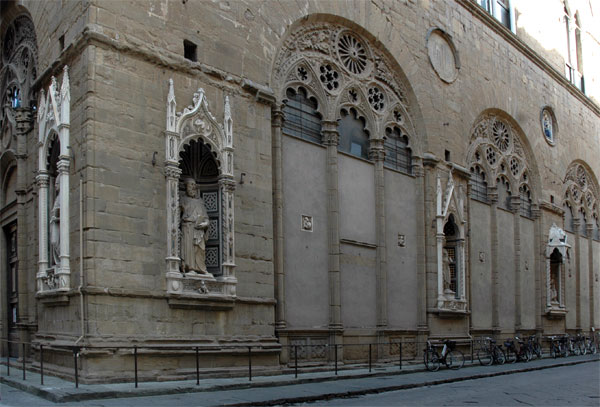
The statue of St. Mark was built in 1413 by Donato di Niccolò di Betto Bardi, also known as Donatello. It was commissioned by the linen drapers’ guild to decorate the guild's niche of Orsanmichele in Florence. Built as a grain market in 1337, Orsanmichele was converted into a church in 1404 for Florence’s trade and craft guilds. St. Mark was one of Jesus disciples who dedicated his life to spread the message of Christianity throughout the world. It is not really clear why Donatello chose St. Mark as a representative figure for the guild but this post is about the statue itself, not St. Mark as a person.
The face of Orsanmichele
Donatello presents us St. Mark in a standing completely naturally. With his weight on the right leg and the slight bend in the left knee this pose reminds us of ancient Greek and Roman sculptures and is also known as “contrapposto”. St. Mark looks alive, as if he could walk away any second. This can be seen not only in the way he stands but in the whole realistic composition of the statue. It is the way the clothing allows us to get an idea of the body underneath, the detailed hands and feet, and above all the individual and specific face Donatello shows us of St. Mark. It seems as if he is seeing further and seeing past us. He expresses an internal focus, an awareness of himself and his surroundings. In creating this 7 feet and 9 inches tall marble statue, Donatello revived the classical ideas of ancient Rome and Greece and joined them with the tenets of the Renaissance. In class we spoke about the pride and the strong beliefs the residents of the Italian City States felt. With his statue of St. Mark, Donatello built a figure that shows the Florentines a sense of their own dignity for their city. St. Mark was kind of a mirror, who ennobles them to rise to their own ideas and by that to individuality and self-reflect.
Donatello who also was in favor of the Medici family, did not only mirror the emerging individualism in that time period, but determined a change in artistic taste. The highly stylized and unnaturally perfect and sometimes lifeless Gothic style was replaced by a more natural and realistic movement. We also saw that development in the works of Giotto.
Donatello, by the way, didn’t just showed us the civic pride in terms of St. Mark, he also demonstrated his own confidence in ignoring the demand of the guild members to change the proportions of the statue. They wouldn’t believe Donatello that he had to shorten St. Mark’s legs and to enlarge his hands to make it seem proportionate from the proper angle. Donatello just pretended to work on the adjustments but did nothing for two weeks. Once the statue was properly situated in the niche, the guild members were pleased.

Sources:
http://smarthistory.khanacademy.org/donatello-saint-mark.html (It is another really good video from the Khan Academy. It’s worth watching it!)

The lovely "Laura"

Portrait of Laura, celebrated in his poetry by Francesco Petrarch (1304-1374), he was known as quote," Father of Humanists". I chose this portrait of Laura because not only did Petrarch was madly in love with her or as we would say almost obsessed, but their mysterious relationship is quite interesting.  As Zophy stated," Petrarch immortalized her charms in his increasingly popular Italian sonnets. he called her the candid rose, thorn compassed and shy, and yet our age's glory and despair." (Zophy, 72) And according to Wikipedia," In his "Secretum", she refused him for the very proper reason that she was already married to another man. He channeled his feelings into love poems that were exclamatory rather than persuasive, and wrote prose that showed his contempt for men who pursue women." Although Petrarch did not win over the fair lady he did make a name for himself as Zophy explains," Petrarch developed many of the fundamental ideas of Renaissance humanism and influenced generations of thinkers, both men and women." (Zophy, 73)
 

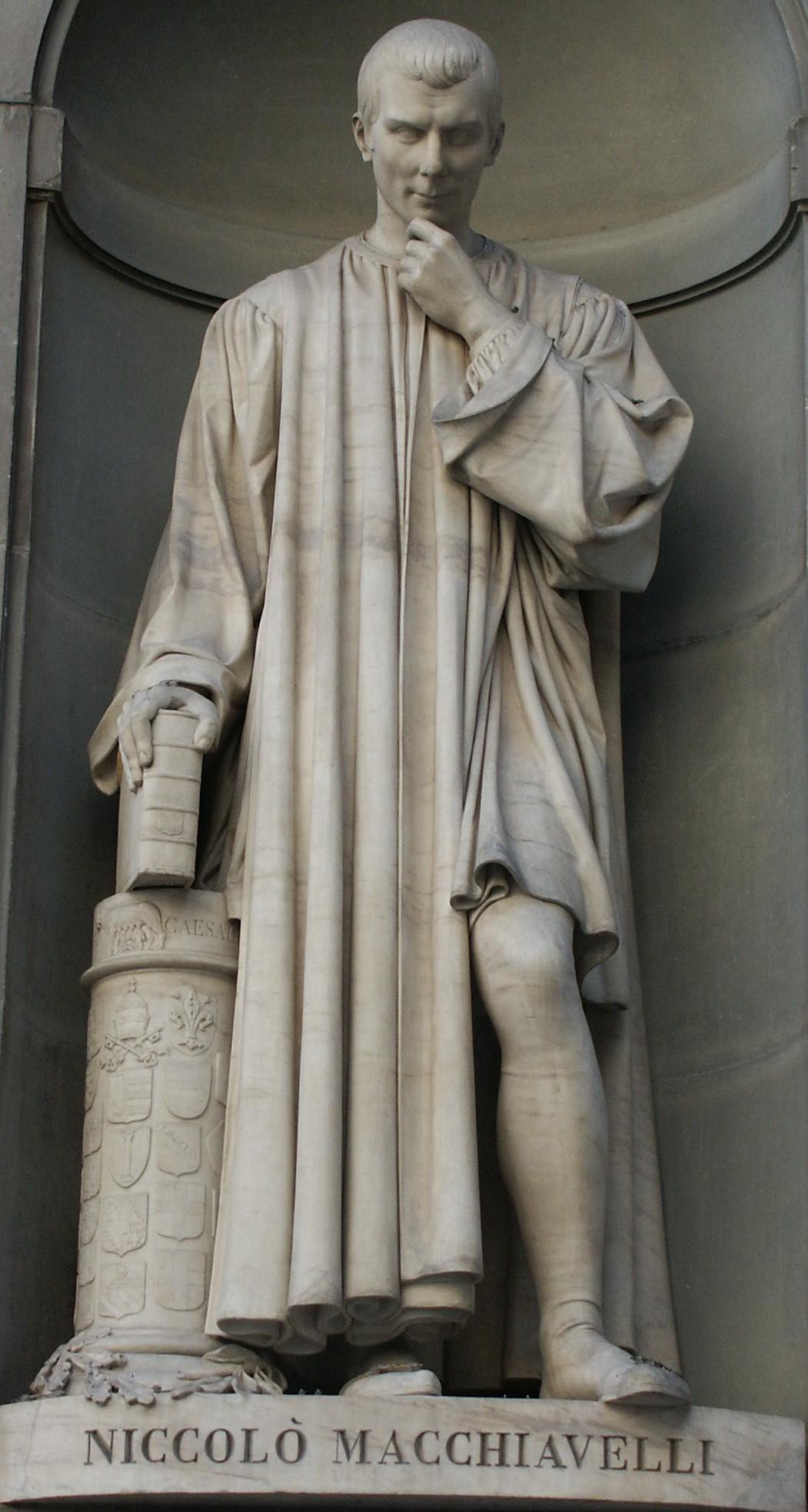
Niccolo Machiavelli


  Even though we did not have time to cover Niccolo Machiavelli in class he played a very key role in the study of humanities during the Renaissance. He lived in Florence and was highly educated, he studied Roman law, Latin, and Italian Literature. He used his education to better his community. He volunteered in his community, worked as a clerk in the government, was appointed chancellor of the Second Chancery, and was a secretary to the Council of Ten. Eventually Machiavelli retires in the year of 1513 after a change in power in Florence to the Medici. Machiavelli lost his job, and as Jonathan W. Zophy casually states in our textbook, "After a period of torture and imprisonment, he was allowed to retire to a small farm outside Florence as a gesture of good will..." This doesn't sound like a retirement party I would want.
  Although the life of Machiavelli is interesting, the most intriguing thing about him to me is his philosophy on politics. Machiavelli wrote more than one book but in his The Prince he writes a "how to" guide for a how a prince should behave in all aspects of his life. This is where Machiavelli's lions and foxes comes from, he states that a prince should be like a lion in order to be strong and scare his enemies as well as smart like a fox to elude his enemies traps (Zophy. 81). This a very different thought on political theory compared to previous philosophers. But Machiavelli's new thoughts on power and the control of a states subjects are what make him such an interesting thinker/humanist of the Renaissance.