Thursday, September 19, 2013

Portrait of a Man

Portrait of a Man (about 1475-6)
Portrait of a Man? That sounds pretty unspectacular, doesn’t it? But look at the picture for an instance: Who is that guy? Why does he stare at us like that? And why couldn’t he even shave properly for his own portrait?
             
Let’s start with the artist of this painting: Antonello da Messina. He was born around 1430 in Sicily and trained in Naples. At that time the city was pretty much a cosmopolitan art center, which means Antonello probably got to know the Flemish artists such as Jan van Eyck (who painted the Arnolfini Portrait we discussed in class). Vasari made up the legend, in which Messina studied with van Eyck in Flanders and after that actually introduced the art of oil painting in Italy. Modern art historians very much doubt this story but it can’t be denied though, that Messina was one of the first artists in Italy, who worked with this new method. In class we talked about how oil paint qualifies for a detailed and precise way of painting.
            In this portrait Antonello shows us exactly this feature, which made oil painting so popular. The face of the man is painted in an exceedingly fine and realistic way. We can point out his beard stubble with the pores just darkening, the hair, which is sticking out under the red cap, the smooth skin tones; even the blouse looks as if one can feel the soft leather of it. (For a closer view click here!) Antonello portrayed this man in remarkably details, which celebrates the new Renaissance art of painting.
            We discussed the fact, that portraits became more important during the Renaissance in class. Antonello though takes a step forward. He doesn’t just present us a typical Italian noble man, who commissioned his own portrait but an unknown middle-upper class man*, who above all sees us directly in the eyes. It is a look with emotional strength and intelligence. The look of a Renaissance man, who seems to has more important things to think about than shaving.            
With this post I wanted to introduce you to another brilliant painter, who is not mentioned in our textbook but who definitely exercised the art of oil painting in an astonishing way.

Sources:

*According to Wikipedia: http://en.wikipedia.org/wiki/Portrait_of_a_Man_%28Antonello_da_Messina,_London%29

Michelangelo's Moses

Michelangelo was what some would consider a renaissance man. He traveled a lot between Florence and Rome.On one of these trips to Rome, he was commissioned by Pope Julius II, also referred to as Papa Terrible, to build his tomb. The tomb was to be three stories tall and full of sculptures. Because of the time restraints and the Pope having michelangelo do other works of art as well, Michelangelo was only able to complete three of the statues.
Moses San Pietro in Vincoli.jpg
One of the statues that Michelangelo was able to complete was Moses. Michelangelo put great detail in the human form trying to make it as real as possible. Moses has great detail in his beard because the sculpture was originally supposed to be on the second floor with people looking up at it. Michelangelo said that to make his sculptures he envisions what he wants the sculpture to look like and then takes away the exterior to reveal his art.

Goddess of love

As we learn from class,  artists such as Titian and many more were intrigued by religious scenes and themes from classical Greeks and Roman mythology. Therefore i chose Titian Venus of Urbino. This painting was completed in 1538 for the duke of Camerino. (Zophy 100) Zophy describes Titian's sensual goddess of love has just been awakened, looking at us with a calculating stare.(100) which is quite extraordinary, i don't remember viewing another painting especially a women who is naked and staring at the painter. Which i find portrays her as very confident. I also really like the details of realism and depth that Titian brings about her hair. It shows Venus as a lovely lady even if shes naked and staring at us. Zophy continues to explains in the background a servant looks for something in a clothes chest while another splendidly dressed woman looks on. (100) Which i am not clear on Titian message about this painting background, i wonder why he added the fully dressed women looking at the servant digging for clothes in the chest. hmm..

The Last Supper


Leonardo da Vinci, possibly one of the greatest all around talents of the Renaissance, composed many artistic works.  One of his most famous works, known as The Last Supper, is a household staple for people of all kinds.  According to arthistory.com, it is the most reproduced image portraying religion. It took three years, from 1495-1498 for da Vinci to complete his work.  This image reveals the biblical scene of Christ accompanied by the apostles.  Located on the wall of a dining hall inside of a Convent in Milan, Italy; da Vinci's masterpiece still astounds viewers today. 

As we take a closer look at the painting, we can see the many vibrant colors (or what is left) throughout the composition.  The wear and tear of years has taken some of the life out of the painting, but the decay of this image can also be attributed to Leonardo's methods of applications.  According to the website, da Vinci used a dry plaster for his painting instead of the more traditional methods of wet plaster.  Little did da Vinci know that this would be the downfall to his own masterpiece.  Within years the dry plaster would start to peel and tear apart.  Every since, historians have worked diligently to try and keep the painting restored.  Da Vinci's method of dry plaster was not intended for the damage of his painting, but instead to allow all of the colors and details to become more dramatically enhanced.  We can also notice that in this image, Christ has no feet.  According to the website, this is simply because modifications were made to the building after da Vinci had completed the painting and a door was added almost directly into the image.  As our book by Zophy explains, da Vinci was known for his incompletion of paintings.  However, the Last Supper was one of his few works that was fully completed (Zophy 96).  We can also see the great amount of detail within the painting.  each member portrayed in this work has their own personality and facial expression.  From left to right, it is evident that each character gives their own personal message. Da Vinci viewed real life human props to create his delightfully detailed depiction of the disciples and of Christ.  Such realism combined with the story and color has landed this image a spot in the history books for many years to come.

Sources: http://arthistory.about.com/cs/leonardo/a/last_supper.htm
Jonathan W. Zophy, A Short History of Renaissance and Reformation Europe: Dances Over Fire and Water

Artemisia Gentileschi - "Judith Slaying Holofernes"


     Artemisia Gentileschi began her life quietly enough as the oldest child of a painter and his wife in Rome. Being born a girl gave her limited options to learn a trade, luckily for her though her younger brothers did not have a painting ability so her father trained her instead. Artemisia received more instruction from the master Caravaggio who was a friend of her father’s. She learned the usage of light and shade to amplify emotions under his tutelage. Unfortunately, for Artemisia her teacher died when she was only seventeen (Zophy 103). Even worse was following the death of her teacher, another painter friend of her father’s raped her. The court did find Agostino Tassi guilty of the charge but released him after a relatively short period, only eight months. For Artemisia, this signaled her time to leave Rome. Her father connected her to Christina de’Medici in Florence (Zophy 103). She received patronage from the Medici family and immediately moved to Florence. Thus in 1616 she became the first woman admitted to the Florentine Academy of Design (Zophy 103). This prestigious honor came at the perfect time, when her art was beginning to gain popularity in many circles of people, no longer just the Medici family.

     Her masterpiece focused on the biblical heroine Judith. She painted many different versions before creating the final one named Judith Slaying Holofernes (Zophy 103). Judith murdered the tyrant Holofernes and brought his head back to the Hebrews in the biblical story. Artemisia offers a very violent painting that shows the murder with the finesse of detail even with the strong story matter. The center of the painting shows Judith and her maidservant killing the tyrant Holofernes. Although this is considered part of Renaissance art considered Artemisia completed it in the year 1611, it is closer to early Baroque styles. Yet one can still see the usage of dramatic emotions, the use of Chiaroscuro, and most importantly, the naturalism of the characters depicted. Another key item in Artemisia’s style is the simplistic background; this is very different from the use of solid color during the Byzantine period. Artemisia’s simple backgrounds instead lend themselves to further focus the viewer on the story and not the minutiae of the background. Some claim that Artemisia created this masterpiece using the pent up rage from her own rape, now whether this is true or not does not matter. It is important to note though because the argument says that she created this purely from anger, instead of her own innate and learned talents.

-Jenn Kervian

Tuesday, September 17, 2013

Il Divino - Michelangelo

We briefly discussed Michelangelo's David at the end of class on Monday. This giant, freestanding statue, was created in 1501 up until 1504. It stands in the Galleria dell' Accademia in Florence. It is made out of Carrara marble, the same kind of marble that was used in Michelangelo's Pieta. The statue was originally intended to be placed in a niche high up on the Cathedral of Florence until it was completed. When Michelangelo revealed his work, they came upon a conclusion that " it was too beautiful to be placed up high" (smarthistory). Instead, the city of Florence decided to place it in front of the Signoria, which if we remember from class is the town hall, for all to see its divine beauty.
The picture to the right is from my visit to Florence in the summer of 2012. This is outside the Signoria where the original would have stood, now it is just a replica. And the picture below is the statue in the Galleria in Florence.
I have actually been to the Galleria dell' Accademia in Florence to see this statue. It is absolutely massive, smarthistory says it is over 14 feet tall. In this picture above you can really get an idea of how big the statue really is. If you look at the bottom you can see the heads of people standing in the crowd. I think the thing that everyone notices when they see this is first how big it is, then the precision and detail Michelangelo uses for the body of David. The detail of his muscles and entire body is so define, it is amazing to think that someone can produce such detail out of a block of marble. When Michelangelo made this statue he was fairly young, the only other major work he did was the Pieta that sits in St. Peter's Basilica in Rome.

http://smarthistory.khanacademy.org/Michelangelo-David.html
Renaissance and Reformation Europe textbook, Zophy. pp 110-111

Monday, September 16, 2013

Hidden Messages


File:First Day of Creation.jpg                It was noted in class today that in the Moses in Pope Juilus II's tomb had a small set of horns on the head of the sculpture.  This has been debated by art historians that this could have possibly been a secret way Michelangelo showed his disdain for the Pope.  This sparked my interest and I decided to see if there have been any other hidden messages in Michelangelo's work.   One possibility could be in the paintings of the Sistine chapel.   The Separation of Light and Darkness which was most likely completed around 1512 is a panel in the Sistine Chapel, the entire ceiling took from 1508 to 1512 (I did take this information form wikipedia, it was just the dates so I figured it would be okay).  The painting of God represents a day in the creation of the Universe. It shows the creation of light and separation from darkness.  


                One highly unusual aspect of the painting is the neck of God.  The neck is very irregular and shows many different convolutions and exaggerations.  In addition there is a very defined fabric wrinkle running down the chest of God from his neck down to his torso that eventually splits into two cylinders.  One theory that has been suggested is that the neck is supposed to represent the human brain, and that the fabric extending down the neck represents the optic nerve.  Michelangelo was a huge enthusiast of anatomy and it is very likely that this was a hidden message in his painting, however we will never know with absolute certainty. This hidden message could mean several things.  One suggestion is that it is a comment on the clash between religion and scientific observation (Fields).


Sources can be found here:
Author: R. Douglas Fields
http://blogs.scientificamerican.com/guest-blog/2010/05/27/michelangelos-secret-message-in-the-sistine-chapel-a-juxtaposition-of-god-and-the-human-brain/

Sunday, September 15, 2013

Choose your Layer: Dante/Catholic/Florentine-style

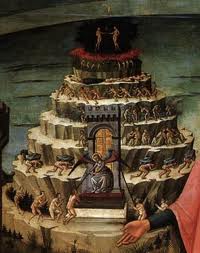
In last week's post, Alex asked us to think about our sins, and I know that many of you have been reflecting on that over the weekend. I wanted to help you out by analyzing in more detail an image from 1465 that I showed in class, "The Comedy Illuminating Florence." It was painted by Domenico di Michelino (d. 1498), who was a Florentine;  this image was displayed within the Florentine Duomo, or cathedral. Notice that the Duomo is also in the picture, as is Dante who truly takes center stage, offering Florence his great work (though he stands outside the city reflecting his exile).

The Divine Comedy, stood as a significant marker for the rebirth of society by later generations, though clearly it was written before the Renaissance. The fact that the image appeared in 1465 in the Duomo tells you much about the self-promotionalism of city-states. The poem that accompanies the painting calls Dante a "master-poet" and  a "father, wise and strong." You can read the epitaph here: www.college.columbia.edu/core/content/la-divina-commedia-di-dante-domenico-di-michelino-1465

The artifact below is indicative of several themes related to Florentine culture that we have been discussing in class. As Zophy remarks, Dante was the author of the The Divine Comedy a series of books on Hell, Purgatory and Paradise. The photograph below was taken from flickr.com, a site where travellers post travel images. Here the painting stands in the cathedral.

When looking at this image you see actually Mt. Purgatory, the doors are right there. And who is at the top? Someone fairly nice--love is in the air! It's Adam and Eve in Paradiso. That's where we want to be, right?  You heard me say that purgatory is not the worst place to be, and this kind of demonstrates that. At least there is a final goal; you simply need to work yourself up the mountain. But where is hell or inferno? It's on the left hand side of the top above image, where all the bodies are crouching in pain. A separate area for which there is NO return.

Finally I wanted to include this image, so you can place yourself more fully. What is your flaw? (one only though right?)