Wednesday, November 6, 2013

Anabaptists


This week we have analyzed the roles of Zwingli and other reformers.  We have also mentioned the roles of the Anabaptists in religious society, and the opposition of some reformers to the ideals of the Anabaptists.  According to the excerpt from the coursepacket, Anabaptists are those who believed in baptism during adulthood.  They believe that baptism was more of a conformation of faith rather than a ritual that should solely be performed at birth.  In this artistic rendering of the Anabaptists from the Anglican Clergyman Daniel Featley's book which was published in 1645, we can see the depiction of the Anabaptists religious ideas.  Featley published his work against the Baptists and used a collection of illustrations to help further his argument.  According to the Wikipedia site, the center of the picture contains naked persons also known as the adamites who took the literal meaning from the scripture that states all should be naked, and not to be ashamed of their nakedness (Wikipedia).  Surrounding the adamites are pictures of specific people with such labels as "separatist", "Georgian", "hemerobaptist", and others.  The raw message of this picture contains a strong view towards Anabaptism, and is undoubtedly the reason why Featley chose to include it in his writings against Baptists.  What sort of message could this send to Baptists or other religions that didn't agree with Anabaptist ideaology? Why would Featley want to provide such raw images of naked adamites in his writings? These are excellent questions to consider when viewing this image and how to interpret it properly.

Sources:

Coursepacket, compiled by Dr. Wolbrink. p. 183.
http://en.wikipedia.org/wiki/File:TheDippersDipt.jpg

Meeting of the Reformers


The Marburg Colloquy could have been a milestone event in the history of the Reformation movement. Landgrave Philip of Hesse invited the leading Protestant reformers to a meeting in Marburg in October 1529. Since the doctrinal controversy between Luther and Zwingli over the Eucharist threatened to divide the Protestants, Philip wished that the participants would come to an agreement. His motivation was also political in the way that he planned to form a strong religious unity, which was able to act as a military alliance against Charles V. Besides Luther and Zwingli, the reformers Philipp Melanchthon, Martin Bucer, Johannes Oecolampadius, Andreas Osiander and several others participated in the meeting.
Religious Colloquium of Marburg, 1557

After a lot of discussions over a couple of days the reformers had in indeed a lot in common but Luther and Zwingli couldn’t agree on their debate over the Lord’s Supper. For Luther Christ was bodily present in bread and wine. Zwingli preferred a more figurative interpretation of the words “This is my body” and denied any form of real presence of the body. In the end both agreed to disagree and the unified alliance Philip went for, dissolved.

1867
         
For this weeks post I found two pictures of the Marburg Colloquy. One is a wood carving (the painter is anonymous), which was made during the 16th century. The other one is an oil painting by the German painter August Noack (1822-1905) from the 19th century. I wanted to show both pictures because I found it interesting how different the scenes of the Marburg Colloquy are depicted. In the wood carving are far less people who are sitting in a circle. We can see some people reading and some gesticulations but the entire scenery seems to be laid-back and more like a talk between old friends. The painting of Noack, on the other hand, looks actually more like a controversial debate. There are a lot of people in the room who are talking to each other. We see more emotion in the faces such as approval or reflectiveness. In the center of the picture, the cross takes a prominent place. Luther and Zwingli are right next to it. Luther is pointing to the Greek word “estin” (“is”), which is written on the table whereas Zwingli points upwards (because Christ ascended to heaven and will return only with the apocalypse).


Sources:

Zophy 203
http://www.britannica.com/EBchecked/topic/364040/Colloquy-of-Marburg
http://germanhistorydocs.ghi-dc.org/sub_image.cfm?image_id=3323

Monday, November 4, 2013

Four Marriages and Eleven Children

(This image of Wibrandis Rosenblatt is the only widely attributed image of her, yet it's creation date is unknown.)

This week there is another woman who offers an interesting perspective on life during the Reformation. Born in 1504 in Bad Säckingen she eventually moved to Basel, Switzerland where she spent most of her life. Her name is Wibrandis Rosenblatt; she married three different reformers during her lifetime, although originally she married a Basel humanist named Ludwig Keller. That first marriage gave her no children.

Her following marriages all are with reformers as mentioned, but most interesting is that they followed similar ideas theologically. Her first marriage to a reformer, Johann Oecolampadious happened in 1528. Oecolampadious proposed and subsequently married Wibrandis due to prodding from his friend another reformer, Wolfgang Capito (Zophy 205). This marriage functioned comfortably and gave Wibrandis three children. Sadly, in 1531 Oecolampadious died, the following year Wibrandis married Wolfgang Capito. This prompted a move to Strasbourg and the birth of five more children. Capito then died in 1541, less than ten years after his marriage began (Zophy 205). Her final marriage was to Martin Bucer in 1542 and they lived together in England, with his death in 1551 after giving Wibrandis another three children. After Bucer’s death, Wibrandis returned to Basel, where she died from the plague in 1564 (Zophy 206).

General Facts not in Zophy came from:

Martin & Music

In class Friday, Dr. Wolbrink mentioned that Luther was quite musical and that he composed hymns, one popular and steadfast example being "A Mighty Fortress Is Our God" (Ein Feste Burg ist unser Gott) which can be found in the modern day hymnal.

This hymn has been translated over 70 times and is modeled after psalm 46 in the Bible. This hymn is rightfully nickname the "Battle Hymn of the Reformation" due to the many circumstances in which it was involved in. It was often sung by a representing Lutheran parties at gatherings such as the Diet of Worms in 1521 and the Diet of Augsburg (aka Augsburg Confession) in 1530. 

Fun fact: This hymn is currently featured in the second edition of the "Catholic Book of Worship" (hmmmmm)

I've had a difficult time finding a recording of the original musical setting...

However, you can click here to listen a lovely variation of the tune by Bach. 

"Ein Feste Burg ist unser Gott" with
Luther's Signature
Early printing, c. 1530


However, Luther ended up contributing far more to music than one hymn. He contributed much to the liturgical use of music including: 36 hymns and tunes, the "Lutheran Chorale" philosophy (producing hymns in the vernacular so that the congregation can participate in music) and overall pioneered the ideology of "church music" for the people. As Wolbrink has pointed out in class, the pre-reformation church service was very much more of a spectator's sport, rather than participatory. The priest would face away from the audience, signifying his connection with God. However, Luther believed that the congregation should be part of the service and should be allowed to experience all aspects (sacrament of blood), including worship through music. Luther could could be compared to Pythagoras in that he believed that music was divine- a gift from the heavens and a vessel of communication with God. Luther used his resources to create music in the vernacular because he believed that the laity should have access to what he considered a vital part of worship. 

Sources: 
http://www.wlsessays.net/files/EggertLuther.pdf
http://en.wikipedia.org/wiki/A_Mighty_Fortress_Is_Our_God
http://www.oxfordmusiconline.com/subscriber/article/grove/music/17219
youtube.com

Sunday, November 3, 2013

Wolfgang Captio

               Wolfgang Capito was a reformer that was referenced in the Zophy text.  Our textbook briefly described him as the reformer which pushed Oecolampadius to marry Wibrandis Rosenblatt.  After Oecolampadius's death Capito married WIbrandis after losing his own wife.  Capito was born in what is now France and was a leader in the reformation.  Educated in German Universities he soon became a Roman Catholic Priest before he joined the reformation. 


                Capito was the leader of the Reformation in Strasbourg and met with Martin Luther several times to help solidify the ideas that were key to his platform.  Capito often found himself in the middle of opposing views.  He tried to help unite the views of the Lutherans and the Zwinglians on the issue of sacraments.   In addition, when many were becoming resentful to the Anabaptist he remained friendly in his earlier years.  He wrote several different books and had publications that were key in the Reformation.   


                What interest me most about Capito is his relationships.  When thinking of history I tend to think of famous people in our past as their own entity without any relationships.  I forget that these people were all interrelated.  It's is amazing imaging Martin Luther and Zwinglian in the same room debating, or Captio persuding Oecolampadius to marry.  

Frederick the Wise, the Catholic/Lutheran


Love the questions about Frederick the Wise in class last week, which ask us all to solidify why we believe something, and why we argue a certain way. 

In my mind Frederick is certainly a Catholic. However it seems that the movie may have created a differing perspective? This is fun. That means I get to check my own logic and find evidence for it. Movies sometimes live larger in our minds than sources. But the reason that historians privilege primary sources is that tell a more accurate tale than secondary sources because they are closer to the past. A movie is a secondary source or an interpretation. 

Although they never met, Frederick protected his fellow Saxon and Wittenberg hero in his dispute with the Italian papacy. For him nationalism trumped allegiance to the Pope. 

Bio of Frederick (used sources from google books and personal Reformation books; new article on Duke Frederick's relics in 16th century Studies article; about 10 sources consulted to help us be exact):

•1486, becomes Duke of Saxony, and one of 7 Electors of HRE (Holy Roman Empire)
•1493, pilgrim to Jerusalem
•1502, founds University of Wittenberg to promote humanist learning (late start for Europe, but demonstrates that timing humanism hits later in Northern Europe; University of Leipzig the most famous University in Saxony)
•hires Lucas Cranach as court painter
•1505, arranges for a large display of all of his relics; by 1509/10, Cranach has sketched every one and put them into a book which circulated through Germany. [see image attached ABOVE by Cranach]
•1516, bans Tetzel from selling indulgences in his region
•1518, Awarded the Golden Rose, a demonstration of special papal regard
•1518, pope treads lightly with Frederick, because needs to request from German princes a special tax of church property to finance crusade against the Turks
•1519, with candidates for Holy Roman Emperor being debated: Pope Leo X switches from King of France to Duke Frederick; he felt that a future Hapsburg emperor Charles would be too powerful, so supports Frederick. 
•June 1519: Frederick steps down from candidacy and  Charles is elected.  A papal-Charles V alliance is created. **Note, this occurs while Luther's ideas spread. 
•1520, refused to burn Luther's books
•1521, protects Luther by kidnapping him
•1525, dies at age 62 in Wittenberg
•buried in Schlosskirche, Wittenberg (buried with Luther and Philip Melanchthon)
•commorated in Lutheran calendar


Thursday, October 31, 2013

It's Complicated


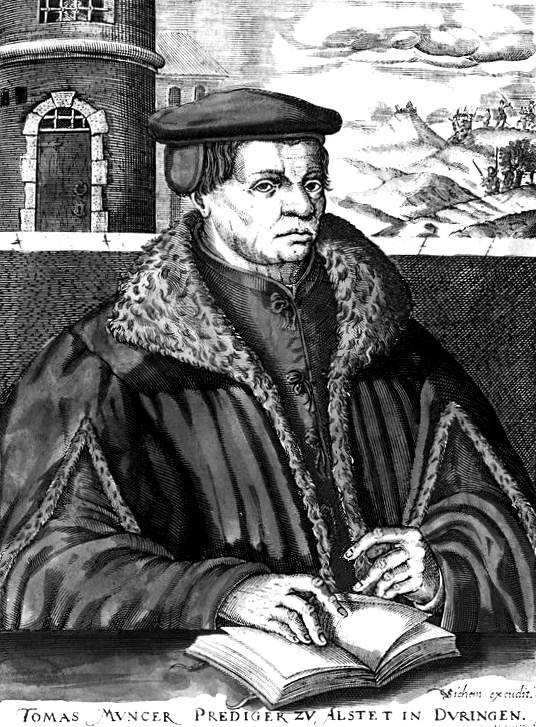
Thomas Müntzer plays a rather interesting role in history. He is a complicated character, making strides in the reformation of the church and even larger strides for the ideas of Marxists. Little is known about his up bringing except that he was the son of a burgher (a member of the wealthy bourgeoisie). He was given a humanist education, becoming a linguist, learning Greek, Hebrew and Latin. Also, completing a course in Biblical theology. Müntzer later became a priest and during this time he became attracted to the works of Martin Luther.

            He studied the works of Luther and was said to have listened to his lectures. However, after all the teachings Müntzer viewed Luther’s ideology of “scripture alone”. With educational background Müntzer felt the need to come to his own conclusions on the interpretation of the Bible.  He took a more extremist view, regarding the passages in revelation.  The apocalyptic passage portrayed the classic struggle between the righteous and evil. It was difficult for him to separate the word from a spiritual and separate perspective, which could be attributed to part of the cause of the peasants revolt. He translated that struggle into the class struggle between the peasants and the wealthy. His revolutionary concept of the inevitable conquest of the anti - Christian earthly government and the thesis that the someone people themselves were the instruments of God and would have to execute this change. He believed that the peasants would lead the struggle against the enemies of the Holy Spirit in the last days, which he believed was the in mid 16th century. (Britannica) During the peasant revolt t he peasants had great faith in Müntzer and later assured his followers that in upcoming war that there would be a divine intervention and their lives would be spared. However, as history states, there was no divine intervention but instead a mass slaughter.

            Yes, this was very tragic but what really intrigued me is how Marxists view this a very crucial part in their history.  Marxists believed that after the apocalypse the world would become a proletariat state where the workers own and run everything. They saw the uprising and his ideologies a foreshadowing of their version of the future.  When East Germany became a communist state they told stories of how Müntzer was a hero, A tragic hero, tragic because of his death. He was a “part of history’s inevitable, inexorable move towards the East German State.” (PBS)

http://www.pbs.org/wgbh/pages/frontline/shows/apocalypse/explanation/muentzer.html
http://www.britannica.com/EBchecked/topic/397713/Thomas-Muntzer
http://gameo.org/index.php?title=M%C3%BCntzer,_Thomas_(1488/9-1525)#1987_Update


On The Jews and Their Lies

The image above is the original title page of On the Jews and Their Lies, written by Martin Luther in 1543. From our course packet we learn that Martin Luther was prejudices against the Jews, and in this section he advises civil and authorities to treat the Jews harshly. I wonder if this started the anti-Judaism which cause people like Hitler to hate and blame everything on the Jews- for the next several centuries. In this book, Luther gives seven regulations that should happen to Jews, the first rule is: Let their synagogues or churches be set on fire (CP).
 Secondly, their homes should be likewise be broken down and destroyed. He even compares them to gypsies (CP). Thirdly, they should be deprived of their paper books and Talmuds in which such idolatry; lies, cursing and blasphemy are taught (CP). Fourthly, their rabbis must be forbidden under threat of death to teach anymore (CP). Fifthly, passport and traveling privileges should be absolutely forbidden to the Jews (CP). Sixthly, they ought to be stopped from usury. All their cash and valuables of silver and gold ought to be taken from them (CP). Last but not least, let them earn their bread by the sweat of their noses as is enjoined upon Adam’s children (CP).  

Even though Luther’s proposals were made against the Jews as the CP states the authorities did not heed his proposals to raze synagogues and homes but some anti-Jewish measures were introduced. And this is where I was wondering about Hitler and his hatred for Jews. Does anyone know if Hitler was a Lutheran?