Sunday, January 31, 2016

Let her go in a fresco


Giotto (1266-1337) was an early renaissance artist who flourished in the artistic style of fresco painting. This style of painting had the artist put their work directly onto the moist plaster by using pigments ground in water so that the paint would be apart of the wall itself.(Zophy 88) This was a very difficult technique that Giotto mastered. Using this technique, he helped revolutionize the artistic era of the early renaissance. Giotto’s platform which he painted on helped him get recognized, but his artistic ability is what helped him stand out from the rest of the artists of the time. Giotto wanted to make sure he grabbed the viewers attention and make them feel what the figures in the painting felt. This was done by giving nearly every one of the subjects an emotion that helped show the severity of the event. An example of this can be seen in Giotto’s fresco painting Death of the Virgin. In this fresco painting the virgin Mary is lying in her death bed while she is accompanied by her friends, family, and angles.


This painting embodies Giotto’s style to a tee with couple of interesting nuances seen within it. Giotto’s personal touch on his paintings is to show emotion with all figures. The grief seen on the faces of those witnessing the death of Mary is very noticeable. From the family to the angels, all show sorrow. One thing that is peculiar about this painting is that there is a significant number of angels present. At this point in time, woman were looked down upon, since Eve led Adam astray and caused the fall of man. Therefore, all woman were viewed as evil. With this in mind, this painting contained more angels than any other painting of its time which shows that Giotto realizes the significance of the event he is portraying. This can be related back to class discussions because Mary is experiencing the final sacrament of a catholic, the anointing of the sick. 

The Crucifixion

Giotto, early Renaissance master, combined naturalism and emotion to connect the viewer to the scene.  Found in the Arena Chapel of Padua, Giotto’s Crucifixion embodies these principles.  In this fresco, Jesus is positioned in the center, hung on a cross above a skull, which signifies that this is Golgotha.  On his left, soldiers are fighting over who gets to keep Christ’s clothes, while on his right, followers of Christ weep.  In this fresco, Giotto breaks away from the medieval style of painting, where subjects are stiff and stylized, with little dimension.  Instead, the figures in this piece stand in a variety of posed and have been painted with much more dimension.  Christ’s body is gaunt, with bones showing, and his hair is damp with sweat. Those gathered around do not stand side by side, but rather in groups, with glimpses of more people behind them, giving a sense of perspective.  The naturalistic method used by Giotto creates a much more life-like image; the viewer could feel like they were watching the crucifixion.


The emotion that Giotto renders in the scene also connects the viewer to the image.  St. Peter looks disappointedly at the bickering Roman soldiers.  All of Christ’s followers and the angels wear expressions of sorrow.  Jesus’s mother swoons in grief as she turns her head away from her son’s lifeless body.  Mary Magdalene expresses her grief passionately as she falls to her knees and weeps over Jesus’s bloody feet.  Giotto was inspired by the mendicant orders cropping up in his time.  The mendicant orders, especially the Franciscans, preached an emotional, energetic sort of spirituality; one should feel the pain of Christ’s suffering and the joy of knowing God.  Giotto’s aim in this fresco is to make the viewers feel the same as those in the painting.  The naturalistic view lets the viewer to feel as though they are in the painting, and the emotions evoke the grief and sorrow the followers would have felt, allowing the viewer to understand and feel the suffering of Christ's Crucifixion.  

Source:

The Evolution of Art as shown in the Ognissanti Madonna


The Ognissanti Madonna or Madonna in Maesta  was a work of art painted by Giotto di Bondone (1267-1337) for the Church of Ognissanti in Florence, Italy. This altarpiece which was 128 inches high and 80 inches wide would have sat behind the altar of the church where all parishioners would have easily seen it during mass and any visitor to the church would have had a easy view of this masterpiece upon entering the church. This painting indicates the Virgin Mary sitting on a throne while holding Jesus as a baby, all while angels kneel before them and people observe from the sides.

Painted in 1310 the Ognissanti Madonna not feature all of the three dimensionality of many of Giotto di Bondone's later works, with several of the onlookers appearing to be quite flat as they look upon the throne. However the painting does break with previous styles as all the characters in the painting are not looking directly forward and even Jesus and the Virgin Mary who are facing forward are seated at angles. Another partial break from earlier artistic styles is the possible representation of movement in the painting with the way baby Jesus has his hand lifted as if to indicate something or grab at his mother which is in contrast to all the other figures in the painting who do not appear to be in the middle of movement. The coloring chosen in the Ognissanti Madonna is interesting to note as well with a heavy emphasis on the reds and yellows which are used in such a way as to not appear harsh. In contrast to the rest of the painting the Virgin Mary is garbed in blue as she usually was when represented in images. The color blue at the time represented royalty and power and was the traditional color to paint the Virgin Mary. This aesthetic choice very much links the Ognissanti Madonna to earlier styles of painting and traditional thought on the subject matter. 

The Ognissanti Madonna has some very clear breaks from previous styles of painting from the angles that all of the characters are represented as being in to the suggestion of movement by Jesus. While at the same time the image has traditional elements showing like the color of the clothing of the Virgin Mary and some flatness in the background of the painting. This suggests that changes in art at the time were not an instantaneous but instead an evolving process that took time to develop.  
         

Ognissanti Madonna - Giotto (Tempera on wood, 325x204)

Sources
"Giotto" Virtual Uffuzi Gallery. 2016. https://www.virtualuffizi.com/giotto.html

"Ognissanti Madonna." Virtual Uffuzi Gallery. 2016. https://www.virtualuffizi.com/ognissanti-madonna.html
"Ognissanti Madonna (Madonna in Maesta) c. 1310" Giotto di Bondone The Complete Works. 2016. http://www.giottodibondone.org/Ognissanti-Madonna-(Madonna-in-Maesta)-c.-1310.html
 

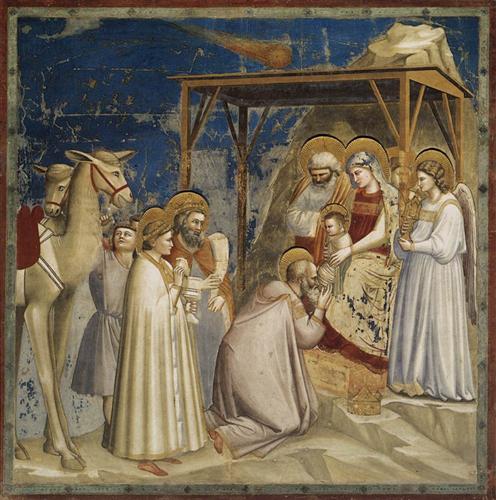
Adorazione dei Magi

Adoration of the Magi - Giotto
The "Adoration of the Magi",  or "Adoration dei Magi" in Italian, is a term traditionally applied to the painting of the Nativity of Jesus with the three "Magi" or wisemen adoring and bestowing the child with gifts. The master naturalist painter, Giotto painted many examples of this subject. The fresco spotlighted in this post was started around 1304 and was completed around 1306. It is a portion of the cycle of frescoes in the Scrovegni Chapel, which is considered one of Giotto's most renowned works.

The scene features Mary, dressed in a red robe edged with gold and a cloak of blue that is almost completely worn away, offering the child Jesus to be adored by the Magi. The draping of cloth, the emotion on the faces of the figures, and the three-dimensionality of the painting showcase Giotto's naturalistic techniques. The Magi can be distinguished by their red shoes, a symbol of royalty and the halos around their heads. The different positions of the Magi showcase the naturalistic style of the painting. One is kneeling and another displays an expression of wonderment at Christ. This is a far cry from the strict and regulated style of Byzantium. The two camels behind the Magi are depicted with extreme detail and care. Behind Mary, Joseph and two angels stand; one of whom is located at the beam of the hut with the beam covering her face, highlighting the naturalism of this painting. A silent dialogue takes place between the faces of those present and they all look very natural and life-like. One of the most interesting components of this fresco is the form of the Star of Bethlehem. It is drawn as a comet shooting through the sky and some theorize that Giotto was inspired to paint this way because of the appearance of Halley's Comet in 1301. 

Sources:

Photo:


Getting Naked with St. Francis

How can we place Giotto in his historical context? One of the new artists to promote linear perspective, emotion, architectural design (see the building above) through partition and lunettes (that half-circle frame above) in his large fresco paintings, he also was a product of his time.  That is, part of looking at artifacts, is also taking a moment to see the interconnections with what is happening in society.  At the Bardi chapel in Florence, a chapel within the larger Basilica of Santa Croce, we have the intersection of wealth and poverty, religion and secular society, and the inspiration of the past.  Commissioned by the Bardi family,  Giotto (and likely his team) painted scenes from the life of St. Francis of Assisi  from 1325-1328. This chapel served as a reminder of the past, a status symbol for the Bardi, and an intimate connection to an inspirational saint. In a single fresco, we must consider the artist, the subject, and the family who commissioned it and to understand how it represents the 1300s.  In this scene, St. Francis signals that his obedience rests with God and the church, while stripping off his familial clothes that represented wealth and society. Being "naked like a naked Christ" was a  popular theological phrase to indicate affinity between two religious beings, God and oneself. So even though St. Francis is literally stripping down, its meaning is more religious than the impact of seeing Francis' armpits, ankles, and slight musculature. Still it is dramatic--which is the intent of art, right?

Why is this image of such high priority? For one, it represents the lessons of religion, charity, and openness to removing oneself from secular power. Secondly, it allows viewers to partake of that moment, and witness a renunciation of power, inviting others to do so as well. But 1300s Italy, and particularly Italian city-states were quite wealthy--as were the 1200s, so that even Francis' dad was a wealthy cloth-merchant. A special few walked away from power, while many remained within secular society. Such images are useful reminders of another life choice that is possible, and yet, if one does not choose that path, one can also look at it and remind oneself of how others have sacrificed. The Bardi family made their money as bankers. Their banking business stretched from Naples to England. To commission an entire chapel dedicated to Francis of Assisi is their way to contribute to, and link to, the religious world; literally we are voyageurs into this dispute between the secular and religious world and the architectural framing reminds us that we are viewing this moment (kind of like a TV set). Yet, we can also walk away from the Bardi chapel and return to our homes. Looking at St. Francis, with his gold halo, we are reminded of what it means to be truly holy (and perhaps thankful it was him, not us?). Perhaps the intersection of religion and society is much closer than we tend to allow?

Saturday, January 30, 2016

The Baroncelli Family Commissions a Master- Giotto


As an early Renaissance artist, Giotto (1266-1337) gained prestige as a fresco painter, adhering to a naturalistic style of painting and depicting realistic human expression (Zophy 88). Although Giotto is known for his portrayals of Saint Francis of Assisi, I will focus on the piece of art at the center of the Baroncelli Polyptych, which is the Coronation of the Virgin. This particular piece was intended as an altarpiece for a church in Florence, commissioned by the Baroncelli family and completed in 1334, late in Giotto's life (wga.hu). This contextual aspect of the work demonstrates the interconnectedness of church and state (or at the least, the ruling class) in terms of power during the period. The family reinforced their own position in Florence through the chapel and their provision of adornments for it- hence the altarpiece. However, the painting itself does not seem to reflect anything remarkably secular, other than the general regality of appearance. Overall, the painting depicts a spiritual scene, one framed by artistic aims of naturalism, order, and unity.

In particular, one can observe the unique sense of naturalism that Giotto infused in the Coronation of the Virgin. For one, the artist utilizes a relatively soft palette of colors, even if the hints of red and the predominant scheme of gold sets up the importance of the scene. The angels, far from otherworldly, appear rather ordinary, brown hair modestly arranged, and clothes merely consisting of simple robes of one color. In fact, their wings attract little attention, folded neatly back and only a soft gold.  Jesus and Mary both appear in white. Interestingly, Mary is perhaps depicted more modestly than typical, with both neck and hair covered, which may be a reflection of matronly status. The most ornate items in the painting are the crown being placed on Mary’s head and the pink/gold patterned fabric wrapped around the two. In general, all the figures in this centerpiece of the Polyptych give a sense of earthly solidness, perhaps indicative of both Giotto’s style and the connection between earth and heaven. In addition, the viewer does have some sense of depth, which Giotto was pioneering in for the period, especially given the perception of distance between the angels and the seated Mary and Jesus (Zophy 88). In terms of gender, it is interesting that Jesus and Mary are both seated and on an equal level, if Mary’s head is still lowered in order to receive the crown. Overall, this painting and its context indicate the importance of religion, the prominence of frescoes, and the secular influence on art in a way that illuminates the culture of the time period.
 
 
Sources:
Zophy, Jonathan W. A Short History of Renaissance and Reformation Europe. Prentice Hall, 2009. Print.


Thursday, January 28, 2016

Giotto's "Madonna and Child": A True Depiction of a Love Between Mother and Son

Florentine painter and architect Giotto di Bondone (1267-1337) painted many Christian images of the "Madonna and Child". However, this blog will focus on the central panel of a polyptych in which the "Madonna and Child" is depicted. Painted between 13010 and 1315 (some argue that it was made between 1320 and 1330), Giotto used tempera on a poplar panel. Tempera, or egg-tempera, is a painting medium that consists of mixing color pigment with egg yolk, creating a fast-drying and permanent paint-like substance. The whole panel mesures 128.3 x 72.1 x 5.1 cm (50 1/2 x 28 3/8 x 2 in).
   As previously mentioned, the depiction of the "Madonna and Child" is the central part of a five- section polyptych. The whole image is influenced by the Byzantine style of painting, where the images were usually very flat, stiff, and inhuman. The background is made of gold leaf, representing the realm of heaven. Furthermore, two gold and very detailed halos surround the heads of Mary and Jesus, revealing their sanctity and holiness. In the Madonna's right hand is a white flower, which symbolizes both Mary's purity and the innocence lost through the Original Sin.
   Even though Giotto was inspired by the Byzantine style, there is nothing Byzantine about the way the two characters are depicted. Giotto used a new naturalistic approach with painting and was able to capture a humanistic representation of the Madonna and Child. Firstly, Mary is not in a complete frontal pose. Her body is slightly turned to the side, towards Jesus. Her face is contoured by shadows and color, bringing about her a certain liveliness. Her blue tunic, which represents the heavens and divinity, moves with her due to the many folds and the great use of shadows. Even though her head and body are slightly turned to the side, her eyes are looking straight ahead, pulling in the viewer. It is as if to say,
 "I have my eye on you. I will protect you".
     As for Jesus, Giotto did not depict him in his usual frontal pose with his hand up in blessing. Instead, the painter gave him a child-like quality by painting him grasping his mother's left index while reaching for the flower that Mary holds, as would any child do. Furthermore, Jesus has the hint of a smile on his face, showing expression and liveliness. His tunic is also painted with minute detail.
     Overall, this Byzantine influenced panel of the Madonna and Child shows great detail and a human interaction between a mother and her child, showing Giotto's talent and innovative new trends in painting.

The panel now resides at the National Gallery of Art in Washington.

Sources:

"Madonna and Child". National Gallery of Art, 2016. http://www.nga.gov/content/ngaweb/Collection/art-object-page.397.html# 

"Madonna and Child by Giotto di Bondone". Web Gallery of Art, 2015. http://www.wga.hu/html_m/g/giotto/z_panel/3polypty/10polypt.html


Tuesday, December 3, 2013

The Four Witches


We learn in class that 80,000 people were accused of being witches, but about 40,000 of them were actually executed. These executions normally were punished by burning at the stake. Such as the image above, in the image it is four witches who were burned at the stake at Wittenberg in 1540 (CP). The four were accused of commerce with the devil and of directing magic against their neighbors (CP). Whether or not “magic” really happens, there were many super situations that easily led someone of being accused of witch craft. Or if you had series of bad luck such as the example Dr.Wolbrink had in class, when the woman’s husband died 3 months after their marriage in a fire, or even after the fact when she remarried, her second husband ended up abandoning her with his first wife. Let’s say you were just weird, you could’ve have been a witch who associated with the devil. Once you were accused, for an example at the age of 20, you wouldn’t actually go to trial until your 40s or 50s. Therefore clearing your name actually took a long time. That probably explains the numbers of people who were accused compared to the lower numbers of people who were actually executed.


Source: Course Packet