Thursday, March 3, 2016

Office of the Night

During the renaissance time period many men were being married around the age of thirty while the women would be married at a much younger age. This distance between ages created a certain type of event to become very popular, especially in cities such as Florence. This event was the act of sodomy. Although not viewed today in the same way as it was back in the renaissance period, back then the idea of sodomy was viewed as a very bad thing. With this event consuming Florence’s bachelors, an organization was formed with the purpose to stop the acts of sodomy. This group was the Office of the Night.  One of the main reasons why the act of sodomy was so common during this time was the fact that men would normally be married around the age of 30; whereas the girls were married around a much younger age. This means that a man in his twenties was likely to be a bachelor until the age of 30. Because a woman’s virginity was a key component for marriage the young unmarried woman of this time were kept under close guard by their fathers, which means that men had to find alternative ways in which to pleasure themselves; thus the act of sodomy. Although the Office of the Night did not have any pictures of their organization (or at least none that I could find) they did keep excellent records of their work. Some of this work can be referred to in the book “Forbidden Friendships”.


Tuesday, March 1, 2016

Who Doesn't LOVE a good painting?

Titian painted the Venus of Urbino in 1538 for the Duke Urbino Guidobaldo II Della Rovere.  Venus, the Roman goddess of love, is depicted as a nude, sensual woman, which was not how women were normally painted at the time; Titian is only able to paint her this way because she represents a Roman goddess, not an Italian woman.  In her hand are roses, and on the window ledge a myrtle plant; both are symbols associated with Venus, and represent the love Venus is offering her: a kind of passion in marriage.  In the background, maids can be seen gathered around an open cassone, or marriage chest. 

The painting was actually commissioned by the Duke as a gift to his wife and serves as an allegory of marriage.  The eroticism in the painting symbolizes the marital obligations the wife would have to fulfill with her spouse.  The sleeping dog at Venus’s feet is a symbol of marital fidelity.  The older maid looking down at the young girl going through the cassone represents motherhood, another expected duty of a wife.

Sources:

Monday, February 29, 2016

I Will Cut You

Being a woman during the Renaissance was hard. Being an acclaimed painter was even harder. Luckily for Artemisia Gentileschi (1593-1653), her skill and connections enabled her to be the first ever woman admitted to the Florentine Academy of Design in 1616. She came to be known as the as the most important woman painter of the Early Modern Europe. Unfortunately, Gentileschi was raped at the age of 19, an event that changed her life forever. Strong woman that she was, Gentileschi took her crime to trial and was adamant about putting the man in jail. He was convicted of rape and sentenced to prison for less than a year. Succeeding his releasement, he was invited back into the Gentileschi household. The horrors of her youth were shown in her work. She became fascinated with the story of Judith and Holofernes: after the Assyrians had besieged her city, the strong pious Jewish widow Judith seduced the general Holofernes with the intention of murdering him and saving her people from destruction. She depicted multiples paintings of the story of "Judith Slaying Holofernes".
    My favorite is the one she painted in 1620 in the Baroque style. The strong use of light and shadows, heavily influenced by Caravaggio's style, reveals drama, dynamism, and depth. Gentileschi was not shy to show gore, as blood oozes and splatters from Holofernes' neck onto the white sheets and the women. What is great about this painting is the physical and psychological strength that is seen in both of these women. They are strong young women working in unison, unscared of the brutality of their actions. Judith has her sleeves rolled up and holds a firm grip on the sword. Her body is not frail nor fragile. Her gaze is focused, her face concentrated: she does not flinch. Her maidservant is depicted similarly, as she has a firm grip on Holofernes and her face is solid. The message is clear: women can be strong and independent, no matter what society says.
   
The image is currently located at the Uffizi Gallery in Florence.

Here is a link that further explains the painting:
https://www.khanacademy.org/humanities/monarchy-enlightenment/baroque-art1/baroque-italy/v/gentileschi-judith

Sources:

Gentileschi, Judith Slaying Holofernes. Khan Academy, 2016. https://www.khanacademy.org/humanities/monarchy-enlightenment/baroque-art1/baroque-italy/a/gentileschi-judith-slaying-holofernes

Artemisia Gentileschi: Biography and Art. Art History Archive. http://www.arthistoryarchive.com/arthistory/baroque/Artemisia-Gentileschi.html


Friday, February 26, 2016

Vicar of Christ or the anti-Christ? Sola Scirptura vs the Supreme Pontiff

Last week Representative Susan DeLemus, a supporter of Presidential candidate Donald Trump, referred to the supreme pontiff as the anti-Christ. This was in response to Pope Francis' remarks that Christians should be building bridges instead of walls and that those who wish to build walls are not Christian. Almost certainly an indirect response to rhetoric coming from Republican frontrunner Donald Trump.

DeLemus' exact words were, "The Pope is the anti-Christ. Do your research." I think I speak for everyone when I say that if someone tells you to "do your research" and they aren't your professor assigning you a research paper, then they really aren't making any credible claim and you shouldn't listen to them. 

Representative DeLemus later clarified that she was referring to the institution of the Papacy as the anti-Christ and not Pope Francis himself. She follows a theological tradition of sola scriptura which rejects papal supremacy and elevates the Holy Bible to that spot. It is worth noting that this tradition posits divine inspiration as the reason for why certain things were canonized into the Holy Bible during the time of the Early Church. This is an answer to the criticism that the Holy Bible was the subject of much debate between scholars and theologians in the Early Church and was canonized in the Council of Nicea in 325 A.D. and then those decisions were largely reaffirmed in the Council of Chalcedon in 451 A.D.

So, is the Pope the anti-Christ? Probably not.Still, how do you explain the invisible horns?


http://www.cathnewsusa.com/2016/02/n-h-lawmaker-backing-trump-calls-pope-francis-the-anti-christ/?newsletter=1

https://www.ewtn.com/library/SCRIPTUR/SOLASCRI.TXT

Tuesday, February 23, 2016

The Cassone: An Ultimate Wedding Gift

 Cassoni, known as forzieri in Renaissance Florence, were wooden chests given to the bride by her family as a gift for her wedding. They were used to transport weddings goods, such as a dowry (clothing, jewelry, accessories) and groom gifts during the wedding procession. They were also stored in the new house of the couple once the wedding was over.  Between the 1370s and 1470s, most cassoni had painted decoration. This was a chance for families and artists to explore themes of love and marriage. The outside of the chest was composed of heraldic devices and narrative scenes, while the interior offered more lewd scenes composed of reclining nudes and putti, representing to bride's expectations to bear children. The most common scenes were those of conquests and triumphs with moral messages about the duties of husbands and wives. Some of the common values that were celebrated were meant for the wife, which included beauty, virtue, purity, duty, and fertility. The scenes depicted were taken from many sources, such as the Bible, Classical myths, and imagery from Ovid, Homer, Petrarch, and Boccaccio.
    An example of a cassone is "The Conquest of Trebizond", painted in the 1460s by the workshops of Marco del Buono Giamberti and Appolonio di Giovanni di Tomaso. The mediums consist of poplar wood, linen, polychromed and gilded gesso with the panel painted in tempera, gold, and silver. The chest is connected with the Strozzi family due to the emblem of the falcon perched on a caltrop at the end piece of the cassone. The subject of the front panel is neither biblical, mythological, nor taken from a novella. It was originally thought that it represented the fall of the city of Trebizond (the last outpost of the Byzantine Empire) at the hands of the Ottoman Sultan Mehmed II. This signified the serious threat that the Turks posed to Europe, which in turn reflected the threat that the elite class of Florence was facing from the merchant class during the Renaissance. However, recent analysis found that the panel may, in fact, reveal the Ottoman forces being vanquished. The artists seemed to have depicted two historical events within one scene: the fall of Trebizond in 1461 and the battle of 1402 when the Ottomans were defeated by the Mongol Emperor and his troops. This represents the idea that the Ottomans were not invincible, reinforcing the belief that Europe was no match for the Ottomans.


The cassone can be seen today at the Metropolitan Museum of Art in New York

Sources:

"The Collection Online." The Metropolitan Museum of Art, 2016. http://www.metmuseum.org/collection/the-collection-online/search/192693 

"Picturing Family and Friends." Italian Renaissance Learning Ressources, 2016.
http://italianrenaissanceresources.com/units/unit-2/essays/husbands-and-wives/

"Cassone with the Conquest of Trebizond." KhanAcademy, 2016.
https://www.khanacademy.org/humanities/renaissance-reformation/early-renaissance1/painting-in-florence/a/cassone-with-the-conquest-of-trebizond


Sunday, February 14, 2016

The Righteous Defender

St Michael Raphael.jpg
              Raphael’s St. Michael originally painted at the request of Guidobaldo da Montefeltro duke of Urbino in 1504. The painting now resides in the Louvre. St. Michael who is an archangel; leader of God’s heavenly host. The painting institutes intrigue as the painting shows Saint Michael vanquishing a demon underfoot. Which is quite possible to be a parallel on how the Duke of Urbino at that time viewed himself as the Dukes of Urbino were renowned leaders who were constantly fighting on different sides of conflicts.

               The painting itself was the first time Raphael painted St. Michael, it is set in a very dark place similar to that of Dante’s Inferno vision of Hell. The lightest point of the painting being the shield of St. Michael. The shield being a protective device representative of how St. Michael is patron saint (protector) of those who fight. (soldiers and police officers) This shows of how St. Micheal protects his own. 

Thursday, February 11, 2016

Daydreams of Apocalypse - Botticelli's "Mystic Nativity"


Looking at artists and artifacts of the Renaissance period this week, I focused on Sandro Botticelli (1444-1510), a well-known painter of the period. Close to Lorenzo de Medici, Botticelli produced paintings both adherent to classical naturalism, yet particularly imaginative in execution (Zophy 90).  He was later influenced by the Dominican friar, Savonarola, who stressed an apocalyptic vision (pbs.org). Therefore, I chose to examine a later painting of Botticelli, one that likely reflects the intertwining concerns of apocalypse with the matured style of the Renaissance master.

“Mystic Nativity,” as it has been named, was painted by Botticelli in 1500, likely for a patron in Florence (nationalgallery.org). The image is first and foremost intriguing for the combined spiritual themes of both beginning (Jesus’s birth) and end (Revelations). The painting maintains Renaissance conventions of style- the symmetrical nature of figures and landscape, the emotive facial expressions of the figures, an overall naturalistic portrayal and a classical approach to nature/beauty.  In the painting, Mary appears as the central figure, kneeled over Jesus, while Joseph is more secondary, even turned away from the viewer’s perspective. The angels located near the earth almost appear as interlopers within the scene, interspersed amongst those who have come to visit the baby Jesus. Three angels perch on the roof, while the large rip or opening in the sky appears both contradictorily peaceful and looming at once. Additionally, the cave-like rock surrounding the small hut could be indicative of Jesus’s resurrection as well. Moreover, demons crawl in the very foreground where the darkest spots (light-wise) lurk in the painting. Consequentially, Botticelli may be rendering time as circuitous, rather than straightforward. On the other hand, the painter may have felt the forthcoming apocalypse to be an immediate danger, narrowing the timeframe from Jesus’s birth to the end of the world. Either or, the painting holds some chaotic urgency, even if remaining true to the stylistic importance of nature and order. In effect, the painting feels more questioning than frightening, blurring lines of reality even in a naturalistic style. Therefore, the painting lends a crucial understanding of the Renaissance period itself: the desire for order, for a rebirth of classicism, for perfection in figure, expression- all relate to underlying reactions to a somewhat chaotic, changing Renaissance world, one that sometimes resulted in beautiful manifestations of fear.


Sources:
Zophy, Jonathan W. A Short History of Renaissance and Reformation Europe. Pearson Prentice Hall, 2009.


Sunday, February 7, 2016

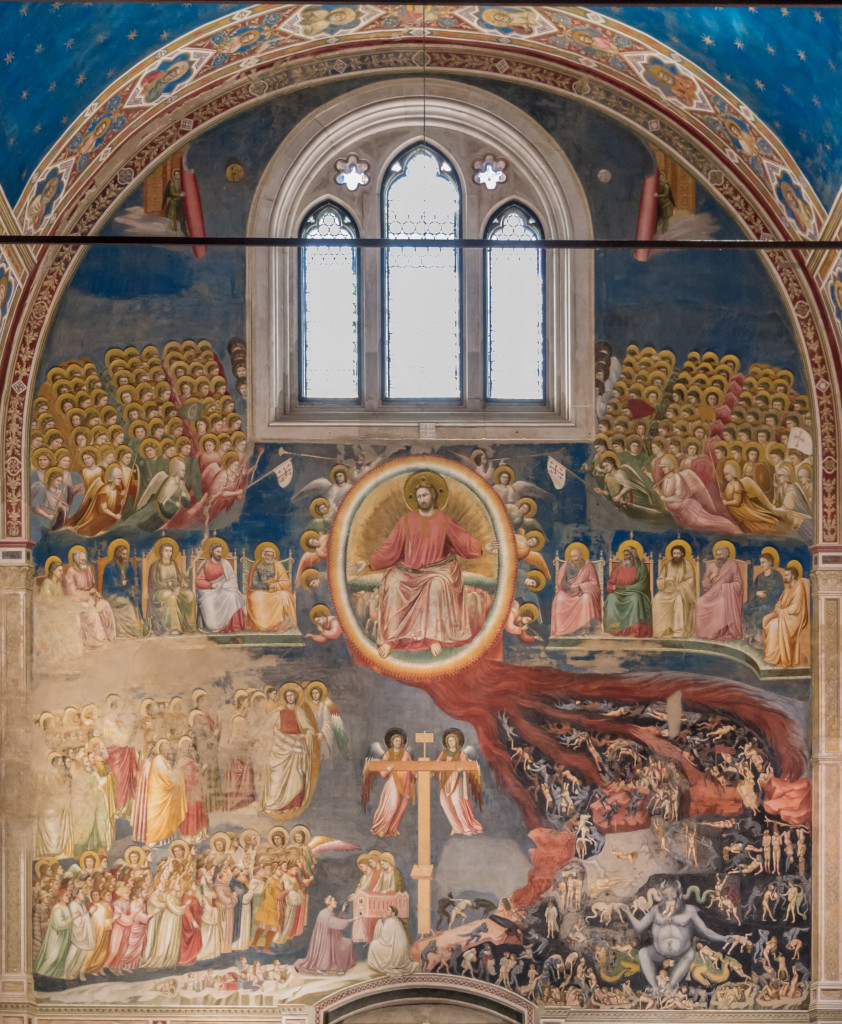
On The Last Day

The Last Judgement by Giotto
Giotto: The Last JudgementThis incredible painting completed by Giotto in 1305 inside the Arena Chapel. Which has the Jesus Christ in the center of the fresco, being the main focus of the work of art. On either side of Jesus Christ are the twelve disciples which form a barrier separating Heaven from all other worlds. The Heavenly host being above Jesus while Earth and Hell reside below Him. The painting shows that the only path to Heaven is through Him Yet failure in this regard to meet the requirements to enter Heaven result in eternal damnation in hell which is on the other side of the cross. Hell is depicted in this fresco as eternal suffering and the people there are trying to seek reconciliation as they are seen attempting to reach out to Jesus.
               This shows how in this period artists were still centered around the church and religion yet were beginning to utilize a more life-like approach to depicting events. Also, along with that, is the fact that a Church could be built of such magnitude which demonstrates the wealth of the region at that point in time. Allowing the peasants of the time period to visualize what was taught to them at Mass, potentially allowing for a greater understanding of the prophecies of what is to come.