Saturday, April 16, 2016

By Faith Alone


This painting, called the Crucifixion with the Converted Centurion, was painted by Lucas Cranach the Elder in 1536.  Lucas Cranach was a painter and engraver who worked for Frederick the Wise of Saxony in Wittenberg.  He painted with bold compositions and intense colors.  Cranach was friends with Martin Luther and worked on many Protestant pieces; he looked after the printing of Luther’s pamphlets, created altarpieces for Protestant Churches, painted portraits of reformers, and made woodcuts for Luther’s Bible.  The influence Protestantism had on Cranach can be seen in his paintings, such as the Crucifixion and the Converted Centurion.  This painting depicts the religious redemption of the centurion.  Jesus is dying on the cross, his body contrasting with the dark and stormy sky.  Inscribed in German are Jesus’s last words, “Father, into thy hand I commend my spirit,” and the the Centurion exclaiming, “Truly, this man was the Son of God.”  This scene displays the Luther’s concept of salvation by faith alone; the centurion, dressed in 1500s armor, represents the “Knight of Christ,” who defends his beliefs against anything.Though he participated in Jesus's crucifixion, the centurion is redeemed through his newfound faith in God.


Sources:
https://www.artsy.net/artwork/lucas-cranach-the-elder-the-crucifixion-with-the-converted-centurion
http://www.nga.gov/content/ngaweb/Collection/art-object-page.46168.html

Dante's Vision

     Purgatory is a place that the roman catholics described as a place "of temporal punishment for those who, departing this life in , are, not entirely free from venial faults, or have not fully paid the satisfaction due to their transgressions." This is a place of temporary punishment and purification. Those in purgatory are destined for heaven and will not be sent to hell. Purgatory played a huge role just before the reformation as the church would take indulgences from family members hoping to help their loved ones move on into heaven. 
      In Bronzino's "Dante gazing at purgatory" he showcases purgatory in a soft way a opposed to other pieces which depict the separation of heaven, purgatory, and hell in a very graphic and violent way. In this piece, Dante is staring at the seven layer mountain of purgatory and just above the mountain is a beam of light depicting heaven.  Just beneath him is a small glimpse of the flames of hell. The reason for having dante in this painting is because he wrote the divine comedy. '“Inferno” (hell) and “Purgatory” are two of the canticles, or major sections of Dante’s famous poem, which he simply titled Comedy"(The Divine Comedy) "but what began to be called “Divine” around the time this picture was made."'


http://catholicherald.com/stories/Dante-prophet-of-the-Year-of-Mercy,30365
http://www.newadvent.org/cathen/12575a.htm

Monday, March 28, 2016

If Only Inanimate Objects Could Speak: Martin Luther's Desk


This simple wooden desk took part in an important event in this history of the Protestant Reformation. It is in fact the desk where Martin Luther translated the New Testament from Greek to German during his exile from the Catholic Church.
    In 1521, Martin Luther was invited to stand before the Holy Roman Emperor, Charles V, at the Diet of Wörms to respond to the charges of heresy following Luther's publication of his 95 Theses. At the meeting, Charles V, backed by Pope Leo X, declared Luther a heretic a banished him from the Holy Roman Empire. Following this, the Elector of Saxony, Friedrich the Wise, invited Luther to take refuge at the Wartburg Castle in Eisenach, Germany where he was confined to the castle walls for ten months. It was during this time that Martin Luther translated the New Testament in the vernacular within eleven weeks, affirming his belief that the bible should be accessible and understandable to everyone.
  The room that is located the desk is called the "Lutherstube", literally "Luther's room" in German.


You can still visit the Castle and the room today.

 Sources:

"Martin Luther and the 95 Theses," History Channel, 2016. http://www.history.com/topics/martin-luther-and-the-95-theses.

"Martin Luther's Life: The Wartburg,"KDG Wittenberg, 1997. http://www.luther.de/en/wartburg.html.


Friday, March 25, 2016

Getting Medieval in NYC: 1850s/2016


When St. Patrick's Cathedral was conceived in New York City in the 1850s,  it was built "for the glory of Almighty God, for the honor of the Blessed and Immaculate Virgin, for the exaltation of the Holy Mother Church, for the dignity of our ancient and glorious Catholic name, to erect a Cathedral in the City of New York that might be worthy of our increasing numbers, intelligence, and wealth as a religious community, and at all events, worthy as a public architectural monument, of the present and perspective crowns of this metropolis of the American continent"(cathedral website).  Fortunate to spend five days there over Spring Break, it was the first thing that I visited upon arriving in the city. I knew that it had been built in little over twenty years, through the Civil War era, and that 103 citizens had grouped together with donations of $1,000 to conceive of a church that would best represent them and their faith. To see the outcome was to see how the past informs the present. 


I arrived at a perfect time. Dusk to late evening. The noise of the city, the yellow taxi cabs, the smells of falafel on the street buzzed around. As a I walked around the corner, the tall spires of the cathedral greeted me. I was thrown by the urban environment of skyscrapers next to what appeared to be a perfectly-shaped Gothic cathedral. While the outside offered rose windows, flying buttresses, and doors that signaled "you are about to enter something really important," the inside offered beauty that was breath-taking, magnified by the free concert inside offering Irish music. The sudden rush of adrenaline that hits me hard made me think of Abbot Suger, a twelfth-century monk and theologian who crafted a treatise on what this kind of architecture means  . . . to soar into the heavens. The long nave, the sacred space of the Baldacchino where the Holy Eucharist is celebrated, the golden cross that appears to stand and stare at the audience, the perpetual prayer candles, and the live music, all served to sharpen the contrast between the worldly city and this sacred center of faith.  

As a scholar of the pre-modern world, I look forward to finding ways that the past has been adapted to the present. With nearly 6 million visitors a year, St. Patrick's cathedral is renowned for its beauty, and the aspect of citizens uniting to build a cathedral (think of all the architectural styles available) in a medieval style (something that Renaissance Italian architects had themselves largely rejected) is appealing.  But I am also teaching a class on the Reformation, so these images are a great reminder of  what a Catholic church represents, then and today. It was no accident that upon entering I saw an image of Pope Francis, who represents the hierarchical framework of the church. Archbishop Timothy Dolan since 2009 has presided over the church and was appointed as cardinal in 2012 (and a St. Louis, Missouri, shout-out to Dolan and midwestern roots). 


Statues, beauty, images: these aspects of religion are central to understanding Faith, Catholics argued, in the midst of some Protestant's attack on the image as false ways to know and experience God. Although some took a very harsh view (termed Iconoclastic, 1520s) and went so far to tear down images, shatter stained glass windows, and smash statues of saints, a large portion of the population found themselves torn between two views. Given some people's propensity to see saints on a daily basis, on street corners, necklaces, and even stories told, it would have been a far tougher break then has been told in some Sunday school classes. That's why myths of St. Luther developed, or even Luther was depicted with a halo, the classic Catholic approbation for a holy person. And that's why some denominations vary considerably in what they consider allowable in religion (dance, song, music, holy mass, stained glass windows, saints, nuns). 

But the other thing that I'm thinking about is how to balance the Protestant critique of money spent on decoration and buildings with this beautiful church. We know that the Reformation began within the context of a major rebuilding of St. Peter's basilica. Just the recent restoration of St. Patrick's cathedral has cost more that $175 million dollars, and the website has a "give now" donation clicker, as well as a gift shop featuring key chains, prayer candles, and bookmarks. Is religion now a commodity, some would argue? Teaching in Rome, I frequently encounter the complaint that the Vatican museum should be free. What is the relationship between money spent and religion revealed in artifacts? That will likely rest in the viewer's belief system. I leave room for multiple opinions. But there are major costs to preserving history and religion that can not be easily calculated. Just sweeping a church with a broom, from all the tourists and pilgrims'  foot traffic is a major endeavor for most churches, for instance, that frequently is assumed stands cost-free. And I was one of these, more tourist for certain, but heading towards pilgrim after getting a few chills from the magnificence of this church.  I was fortunate to feel the decision-making process of the 100 or so citizens that sought to recreate medieval architecture in the modern world. 

Thursday, March 10, 2016

The Beliefs of the Protestant Reformation in a Painting

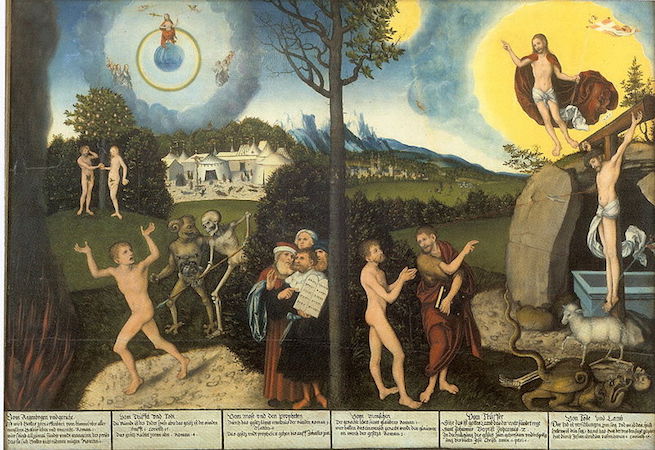
This is The Law and Gospel which was painted by Lucas Cranach the Elder in 1529. A close associate of Martin Luther, Lucas Cranach the Elder is believed to have been born in 1472. Although influenced by Renaissance art Lucas Cranach the Elder is chiefly remembered for his role as a principle artist in the Protestant Reformation and is remembered for his numerous mythological and religious paintings such as Cupid Complaining to Venus and The Law and Gospel and for his work as a portrait artist as he painted numerous members of the royalty of Saxony and even painted a famous portrait of Martin Luther himself. Lucas Cranach the Elder proved to be a highly influential figure in the Protestant Reformation and associated with and influenced many powerful people he met through his art and the various governmental positions he held.     
Lucas Cranach the Elder painted The Law and Gospel in collaboration with Martin Luther and as such there are many religious and spiritual themes and messages that are trying to be conveyed by this image. The primary lesson that is trying to be communicated by this image is that it is only through belief and God's grace and mercy can people ascend to heaven. This is a refutation of the prevailing Catholic belief that people can improve their chances of going to heaven by performing "good works" like donating money to the Church, commissioning art or any other action that the Catholic Church deems worthy. There is a fundamental difference in belief between the relationship of belief itself and actions that is being illustrated by the man going to heaven on the right with Jesus on the cross beside him and the man on the left who is shown next to the law alone. This shows Martin Luther's belief that only through faith coupled with law is heaven accessible and not just adherence to law even if it is divinely inspired. The Law and Gospel is significant for all the complex messages that it conveys about faith and religion and it embodies the essential theological differences in belief that Martin Luther's reformation was built on.  


Sources
André Marie, Faith and Good Works, Catholicism.Org. 2009, http://catholicism.org/faith-and-good-works.html 

Cranach, Law and Gospel(Law and Grace), Khan Academy.https://www.khanacademy.org/humanities/world-history/renaissance-and-reformation/protestant-reformation/a/cranach-law-and-gospel-law-and-grace 

Lucas Cranach the Elder, Cranach Digital Archive. 2016, http://lucascranach.org/lucas-cranach

Lucas Cranach the Elder, The National Gallery. 2016, http://www.nationalgallery.org.uk/artists/lucas-cranach-the-elder


Friday, March 4, 2016

The V Shape

Pregnancy during the Renaissance was fascinating to say the least. One specific aspect of giving birth that I found slightly disturbing was the psychical position of the soon-to-be mother. I found myself cringing at the thought. There were actually a few different positions depending on the situation, but most deliveries were commonly preformed on some type of chair.
(I sat in desk chair to try and imagine what this experience would have been like... go ahead. Try it.)
Turns out these were not just everyday chairs. They were specifically designed for giving birth.

 
When the time was right, the midwife would require the woman to sit in a chair with a v-shaped rim. In order for there to be no pressure under the woman, the center of the chair was hallow and the back of the chair was slanted so the woman could lean back for more comfort and support. This also gave the midwife easy access to the baby.
 
Childbirth: Woodcut from Der Swangern Frawen und he bammen roszgarten, by Eucharius Rösslin, 1513. 
(An imagine displaying the use of a birthing chair.)

The V-shaped chair was more commonly used on women who had already experienced giving birth. First-timers relied on more comfortable positions. 


Sources:
http://www.gallowglass.org/jadwiga/herbs/WomenMed.html
http://www.elenagreene.com/childbirth.html

The Miracle of Birth

The Miracle of Birth was painted by Enea Salmeggio of Bergamo in the early 1600's. The painting has many distinguishing features that relate to life during the time period. The mother is show as sitting on the side of her bed with a person behind her who assisted in giving her a sitting position rather than laying down on the bed which would seem unusual for many modern day people but was common at the time. The priest in the painting just behind the woman appears to be giving a figurative  blessing to the newborn child. The painting features a three dimensional look that was common for the time it was painted yet holds a simplicity to in which was a hallmark of its creator Enea Salmeggio.  Enea Salmeggio was greatly influence by the works of Raphael and sought to include these influences within his own work. Its impressive that the color palate of the painting is mostly composed of reds and red tinted colors yet manages to give the impression of a warmth within the room and atmosphere. The painting is also notable for the expression of movement as the child is passed from who could be presumed to be the midwife to another female servant. Overall the image provides a look an perspective in
to the a personal  moment not as commonly seen in Renaissance era art.


Sources

The Miracle of Birth, YooniqImages,https://yooniqimages.com/images/detail/100705861/Creative/the-miracle-of-the-birth-by-enea-salmeggia-known-as-talpino-1580-1620-about-16th-century-17th-century 

Wornum, Ralph A.Bibliographical Catalogue of the Principal Italian Painters, With a Table of the Contemporary Schools of Italy, (London: Woodall and Kinder, 1855) 

https://books.google.com/books?id=XCtkAAAAcAAJ&printsec=frontcover&dq=intitle:Wornum+intitle:principal+intitle:painters&hl=en&sa=X&ved=0ahUKEwj2wcj70KfLAhVKt4MKHfaRDRsQ6AEINTAA#v=onepage&q&f=false


Midwives in the Birth of the Virgin Mary?

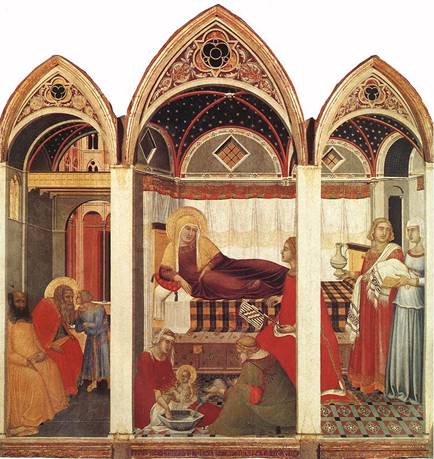
The Nativity of the Virgin is a painting by the Italian painter, Pietro Lorenzetti. It was done around 1335-1342. The painting had been commissioned as part of a cycle of four altarpieces dedicated to the city's patron saints and originally was a secondary altarpiece in the Cathedral of Siena. The painting utilizes linear perspective as the work is separated by two white piers in the foreground and there is a three-dimensio
nality to the living area depicted. The painting is indicative of the Renaissance as the characters, their clothes and surroundings, all have the realism characteristic of the period.

The work is a triptych with the scenes set in the same location. The left scene depicts Mary's father, Joachim, almost being told the birth of the Virgin Mary has occurred outside of the room where the birth occurred and therefore, somewhat removed from the experience. The most interesting feature of this fresco is the two panels to the right. Birthing in Renaissance Italy was a community affair with many women and a midwife helping the pregnant wife through. In Lorenzetti's painting, the community affair of Renaissance childbirth is evident. A woman in red, maybe a midwife, is seen washing the newly born Virgin Mary; women stand, in the rightmost panel, with cloth, waiting to help the resting mother and baby. In total, there are 5 women in the room with the mother during the birth and this would have been pretty standard for the period. The painting shows a Renaissance touch to the old subject of the nativity of Mary.

The painting is now housed in the Museo dell'Opera del Duomo of Siena, Italy.

Credits:
https://www.khanacademy.org/humanities/renaissance-reformation/late-gothic-italy/siena-late-gothic/v/pietro-lorenzetti-birth-of-the-virgin-c-1342
https://en.wikipedia.org/wiki/Nativity_of_the_Virgin_(Pietro_Lorenzetti)

Image:
https://upload.wikimedia.org/wikipedia/commons/c/c7/Pietro_lorenzetti,_natività_della_vergine_del_duomo_di_siena,_1342,_tempera_su_tavola_187x182,_museo_dell'opera_del_duomo_di_siena.jpg