Monday, April 25, 2016

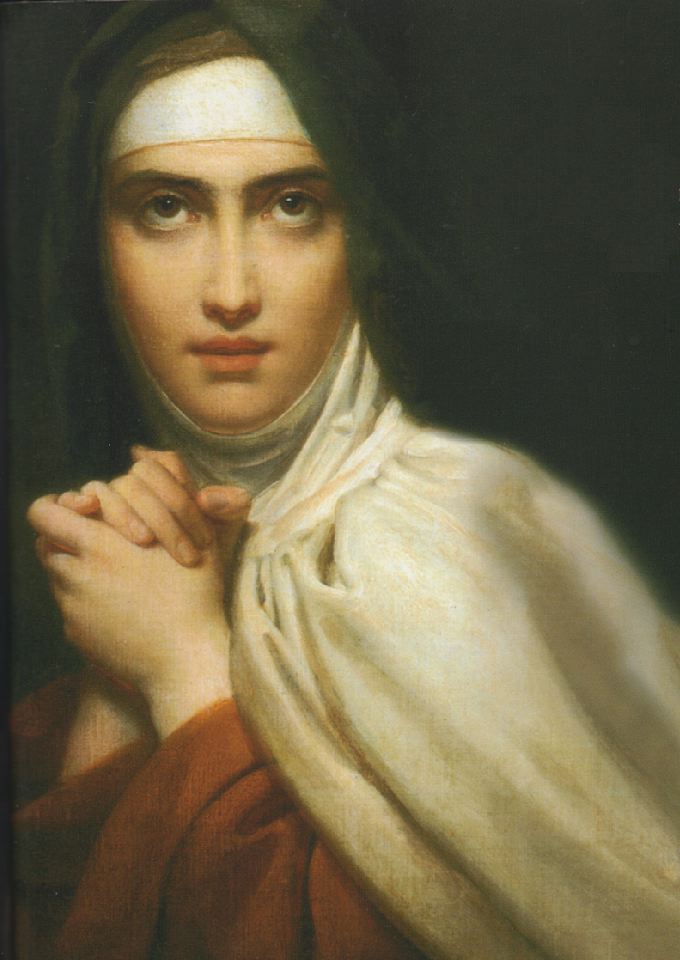
It's in the eyes- Artwork of St. Teresa of Avila

In accordance with our study of the Counter Reformation, I will look at another figure of the period – St. Teresa of Avila – through the lens of two different works of art. Teresa of Avila (1515-1582) is best known for her mysticism, writings, and leadership in the Carmelite order in Spain.  During her lifetime, she remained persistent in the growth of a reform-minded Carmelite order, as well as wrote works such as Way of Perfection and her Autobiography (Zophy 261-262). I desired to compare two works focused on St. Teresa of Avila in order to demonstrate both her own legacy and that of the Counter Reformation.


The first work is Bernini’s infamous sculpture, The Ecstasy of St. Teresa. Sculpted in the years 1647-1652, the work stands as a testimony to Teresa of Avila’s distinct mysticism, as it depicts her in the midst of a religious vision. As the viewer can see, the sculpture retains all the drama of the Baroque period whilst rendering the saint as overwhelmingly beholden to her spiritual vision. Moreover, the facial expressions of both Teresa and the other figure evoke emotion and vivid experience. The multiple folds of Teresa’s garb add further spectacle to the scene. In comparison, the second work, Baron Francois Gerard’s St. Teresa, is altogether different, but this naturally stems from its later time frame (early 19th century) and thus, Romantic style. The portrait simply gives a modest Teresa, with eyes that angled upward convey a subtle link to mysticism, but moreover, convey a blend of piety and mystery. Gerard gives an ideal Teresa, quiet but impactful in beauty and mystery, a spiritual figure from a faraway, lost place (hence approximately two centuries in separation between the portrait and her death).  Bernini equally moves away from reality, but in a way that still seems evocative of the mysticism central to St. Teresa’s character and even the criticism she faced. The works are in truth mostly contrasting depictions of St. Teresa, but they both persist in demonstrating the historical impact of reformers from the period, who tend to appear as stabilizers not defectors after their lifetimes.


teresa_avila_gerard

Sources:

http://www.metmuseum.org/toah/hd/bern/hd_bern.htm
http://www.wga.hu/html_m/g/gerard/7theresa.html

Images:
http://www.artble.com/imgs/d/a/5/431705/the_ecstasy_of_saint_theresa.jpg
https://fraangelicoinstitute.com/2012/10/15/st-teresa-of-avila-on-love/teresa_avila_gerard/

The Mary Rose: Henry's Baby

 The Mary Rose was a carrack-type warship that came to be known as the best ship of Henry VIII's time. She was known for her grandeur, beauty, and success. Succeeding Henry's coronation, the new young King knew he needed a great navy, as England was threatened by both the Scots and the French. At the time, he only had a handful of warships and merchant vessels at his disposal. Therefore, in 1510, construction of the Mary Rose started in Portsmouth, where 600 oak trees were used to build it. The earliest reference of the Mary Rose by name appears in a payment record made by Henri VIII for bringing the ship from Portsmouth to the River Thames.
   The ship's first battle was in 1512 against the French fleet. The ship's captain deemed it "the noblest ship of sail". The Mary Rose fought three battles against the French, before sinking on July 19, 1545 at the Battle of Solent. Many attempts were made between 1545 and 1549 to raise to wreck, all unsuccessful.
    After lying dormant for 300 years, divers John and Charles Deane discovered the wreck and were able to raise guns. However, they eventually lost the site of the wreck. In 1982, the wreck of the hull was raised, and event that was viewed on television by 60 million people worldwide.


    It is believed that the Mary Rose was named after Henry's sister. However, it was most likely named after the Virgin Mary.


Visitors can now visit the ship in Portsmouth- (The Mary Rose Museum, Portsmouth Historic Courtyard)

Sources:

"The Mary Rose", The Mary Rose, 2016http://www.maryrose.org/discover-our-collhttp://www.maryrose.org/discover-our-collection/ection/ 

"The Mary Rose: A Tudor ship's secrets revealed". BBC, 2013. http://www.bbc.com/news/uk-england-hampshire-22639505


Friday, April 22, 2016

A Century Gone- St. Ignatius Lives on in the Baroque

Ignatius of Loyola or St. Ignatius (1491-1556) founded the Society of Jesus in 1534 or commonly known now as the Jesuits. This religious organization admitted men, stressed obedience, and centralized education in preparing their members to serve those who needed help in the world. St. Ignatius represents one major success of the Catholic Reformation, as missionary work, education, and theology flourished within the society’s growth during the period (Zophy 257-260) To demonstrate the lasting legacy of Ignatius, I looked at a fresco painted a century after the death of the Saint himself. The Apotheosis of St. Ignatius was painted in the late 17th century by Andrea Pozzo, a Jesuit baroque painter (Vanderbilt Digital Library). Overall, this work designates the impact of the Roman Catholic Reformation, a contemporaneous influence alongside the Protestant movement at the time. Moreover, this signals the transition in artwork towards the Baroque period, a style of excess that perhaps reflects some of the religious upheavals still affecting society even a century later.

The painting resides in the Church of Saint Ignatius in Rome. As you can see, there’s vivid color and a large array of figures, with Ignatius ascending to heaven in the center of the fresco. The fresco itself creates a sense of daunting height and slightly of chaos. There’s also a distinct portrayal of light and altogether, the ornamentation of the Baroque period comes through. This cultural remnant of a later period imparts the very real notion that reform was active and influential within the Catholic Church during the Reformation period, not just outside of it.


Image & Info- 
http://diglib.library.vanderbilt.edu/diglib-fulldisplay.pl

Extra link- This video is about a different altarpiece by Pozzo of St. Ignatius in a nearby chapel. Has some general information about the style and the significance of a similar work by the same artist. https://www.youtube.com/watch?v=A3vkqYgJ93c

Wednesday, April 20, 2016

Why don't the contemporary Anabaptists (usually) use contemporary technology?

Recently, in his show Family Guy, philosopher and funnyman Seth Macfarlane mocked the traditions of Amish people. He had an Amish character saying, "We know that God wanted us to have just the right amount of technology they had in the 1800s, not too much not too little." While I'm sure the joke was intended to mock the religious and illicit laughter from the audience, it does raise an interesting question:

 Why don't the Amish use contemporary technology? At one point in time they were using contemporary technology. They must have used the same buggies, the same horse-drawn plows, etc., that other groups of people were using in the 1800s. Its not like the 1800s anabaptists were using medieval farming technology while 1800s Catholics were using 1800s technology.

One explanation I found sheds a lot of light on this question, and totally debunks the assertion of the great thinker Seth Macfarlane.

According to the Young Center for Anabaptist and Pietist Studies at Elizabethtown College, the Amish are not anti-technology. Rather, the Amish use technology more selectively. The Amish see contemporary technology, specifically mass media technology, as a means to undermine local traditions which they wish to preserve. Moreover, the Amish fear that mass media technology as well as dependency on things from outside the community will increase rates of assimilation and eventually lead to the extinguishing of their way of life. 

For example, the Amish do use electricity. However, they do not get their electricity from city utilities or power lines. Many Amish purchase batteries and use solar power to charge them. This way they can power lights, use power tools, use typewriters, and many other things without relying on the outside world. However, most communities outright ban the use of things like computers, televisions, radios, and other things which may take outside values and inject them into the community.


Battery powered electric lamp in an Amish home


Buggy with battery powered lights


Therefore, the Amish to not reject technology because "God wanted us to have just the amount of technology they had in the 1800s", but they reject some forms and closely regulate others for purely secular and cultural reasons. 


Sources of information and photos:

https://groups.etown.edu/amishstudies/cultural-practices/technology/
http://www.npr.org/sections/alltechconsidered/2013/09/02/217287028/amish-community-not-anti-technology-just-more-thoughful

Saturday, April 16, 2016

By Faith Alone


This painting, called the Crucifixion with the Converted Centurion, was painted by Lucas Cranach the Elder in 1536.  Lucas Cranach was a painter and engraver who worked for Frederick the Wise of Saxony in Wittenberg.  He painted with bold compositions and intense colors.  Cranach was friends with Martin Luther and worked on many Protestant pieces; he looked after the printing of Luther’s pamphlets, created altarpieces for Protestant Churches, painted portraits of reformers, and made woodcuts for Luther’s Bible.  The influence Protestantism had on Cranach can be seen in his paintings, such as the Crucifixion and the Converted Centurion.  This painting depicts the religious redemption of the centurion.  Jesus is dying on the cross, his body contrasting with the dark and stormy sky.  Inscribed in German are Jesus’s last words, “Father, into thy hand I commend my spirit,” and the the Centurion exclaiming, “Truly, this man was the Son of God.”  This scene displays the Luther’s concept of salvation by faith alone; the centurion, dressed in 1500s armor, represents the “Knight of Christ,” who defends his beliefs against anything.Though he participated in Jesus's crucifixion, the centurion is redeemed through his newfound faith in God.


Sources:
https://www.artsy.net/artwork/lucas-cranach-the-elder-the-crucifixion-with-the-converted-centurion
http://www.nga.gov/content/ngaweb/Collection/art-object-page.46168.html

Dante's Vision

     Purgatory is a place that the roman catholics described as a place "of temporal punishment for those who, departing this life in , are, not entirely free from venial faults, or have not fully paid the satisfaction due to their transgressions." This is a place of temporary punishment and purification. Those in purgatory are destined for heaven and will not be sent to hell. Purgatory played a huge role just before the reformation as the church would take indulgences from family members hoping to help their loved ones move on into heaven. 
      In Bronzino's "Dante gazing at purgatory" he showcases purgatory in a soft way a opposed to other pieces which depict the separation of heaven, purgatory, and hell in a very graphic and violent way. In this piece, Dante is staring at the seven layer mountain of purgatory and just above the mountain is a beam of light depicting heaven.  Just beneath him is a small glimpse of the flames of hell. The reason for having dante in this painting is because he wrote the divine comedy. '“Inferno” (hell) and “Purgatory” are two of the canticles, or major sections of Dante’s famous poem, which he simply titled Comedy"(The Divine Comedy) "but what began to be called “Divine” around the time this picture was made."'


http://catholicherald.com/stories/Dante-prophet-of-the-Year-of-Mercy,30365
http://www.newadvent.org/cathen/12575a.htm

Monday, March 28, 2016

If Only Inanimate Objects Could Speak: Martin Luther's Desk


This simple wooden desk took part in an important event in this history of the Protestant Reformation. It is in fact the desk where Martin Luther translated the New Testament from Greek to German during his exile from the Catholic Church.
    In 1521, Martin Luther was invited to stand before the Holy Roman Emperor, Charles V, at the Diet of Wörms to respond to the charges of heresy following Luther's publication of his 95 Theses. At the meeting, Charles V, backed by Pope Leo X, declared Luther a heretic a banished him from the Holy Roman Empire. Following this, the Elector of Saxony, Friedrich the Wise, invited Luther to take refuge at the Wartburg Castle in Eisenach, Germany where he was confined to the castle walls for ten months. It was during this time that Martin Luther translated the New Testament in the vernacular within eleven weeks, affirming his belief that the bible should be accessible and understandable to everyone.
  The room that is located the desk is called the "Lutherstube", literally "Luther's room" in German.


You can still visit the Castle and the room today.

 Sources:

"Martin Luther and the 95 Theses," History Channel, 2016. http://www.history.com/topics/martin-luther-and-the-95-theses.

"Martin Luther's Life: The Wartburg,"KDG Wittenberg, 1997. http://www.luther.de/en/wartburg.html.


Friday, March 25, 2016

Getting Medieval in NYC: 1850s/2016


When St. Patrick's Cathedral was conceived in New York City in the 1850s,  it was built "for the glory of Almighty God, for the honor of the Blessed and Immaculate Virgin, for the exaltation of the Holy Mother Church, for the dignity of our ancient and glorious Catholic name, to erect a Cathedral in the City of New York that might be worthy of our increasing numbers, intelligence, and wealth as a religious community, and at all events, worthy as a public architectural monument, of the present and perspective crowns of this metropolis of the American continent"(cathedral website).  Fortunate to spend five days there over Spring Break, it was the first thing that I visited upon arriving in the city. I knew that it had been built in little over twenty years, through the Civil War era, and that 103 citizens had grouped together with donations of $1,000 to conceive of a church that would best represent them and their faith. To see the outcome was to see how the past informs the present. 


I arrived at a perfect time. Dusk to late evening. The noise of the city, the yellow taxi cabs, the smells of falafel on the street buzzed around. As a I walked around the corner, the tall spires of the cathedral greeted me. I was thrown by the urban environment of skyscrapers next to what appeared to be a perfectly-shaped Gothic cathedral. While the outside offered rose windows, flying buttresses, and doors that signaled "you are about to enter something really important," the inside offered beauty that was breath-taking, magnified by the free concert inside offering Irish music. The sudden rush of adrenaline that hits me hard made me think of Abbot Suger, a twelfth-century monk and theologian who crafted a treatise on what this kind of architecture means  . . . to soar into the heavens. The long nave, the sacred space of the Baldacchino where the Holy Eucharist is celebrated, the golden cross that appears to stand and stare at the audience, the perpetual prayer candles, and the live music, all served to sharpen the contrast between the worldly city and this sacred center of faith.  

As a scholar of the pre-modern world, I look forward to finding ways that the past has been adapted to the present. With nearly 6 million visitors a year, St. Patrick's cathedral is renowned for its beauty, and the aspect of citizens uniting to build a cathedral (think of all the architectural styles available) in a medieval style (something that Renaissance Italian architects had themselves largely rejected) is appealing.  But I am also teaching a class on the Reformation, so these images are a great reminder of  what a Catholic church represents, then and today. It was no accident that upon entering I saw an image of Pope Francis, who represents the hierarchical framework of the church. Archbishop Timothy Dolan since 2009 has presided over the church and was appointed as cardinal in 2012 (and a St. Louis, Missouri, shout-out to Dolan and midwestern roots). 


Statues, beauty, images: these aspects of religion are central to understanding Faith, Catholics argued, in the midst of some Protestant's attack on the image as false ways to know and experience God. Although some took a very harsh view (termed Iconoclastic, 1520s) and went so far to tear down images, shatter stained glass windows, and smash statues of saints, a large portion of the population found themselves torn between two views. Given some people's propensity to see saints on a daily basis, on street corners, necklaces, and even stories told, it would have been a far tougher break then has been told in some Sunday school classes. That's why myths of St. Luther developed, or even Luther was depicted with a halo, the classic Catholic approbation for a holy person. And that's why some denominations vary considerably in what they consider allowable in religion (dance, song, music, holy mass, stained glass windows, saints, nuns). 

But the other thing that I'm thinking about is how to balance the Protestant critique of money spent on decoration and buildings with this beautiful church. We know that the Reformation began within the context of a major rebuilding of St. Peter's basilica. Just the recent restoration of St. Patrick's cathedral has cost more that $175 million dollars, and the website has a "give now" donation clicker, as well as a gift shop featuring key chains, prayer candles, and bookmarks. Is religion now a commodity, some would argue? Teaching in Rome, I frequently encounter the complaint that the Vatican museum should be free. What is the relationship between money spent and religion revealed in artifacts? That will likely rest in the viewer's belief system. I leave room for multiple opinions. But there are major costs to preserving history and religion that can not be easily calculated. Just sweeping a church with a broom, from all the tourists and pilgrims'  foot traffic is a major endeavor for most churches, for instance, that frequently is assumed stands cost-free. And I was one of these, more tourist for certain, but heading towards pilgrim after getting a few chills from the magnificence of this church.  I was fortunate to feel the decision-making process of the 100 or so citizens that sought to recreate medieval architecture in the modern world.