Friday, September 20, 2013

Gathering of the Greatest Minds Throughout History


  This is School of Athens by Raphael. I chose this painting after I read about it in our Zophy text book. The concept of Raphael's painting is incredible. This is "...a glorious, humanist tribute to many of the legendary sages of antiquity"(Zophy, 98-99). It places all of the greatest minds in history together disusing their theories in one setting, a school in Athens. This painting contains Aristotle, Plato, Pythagoras, Ptolemy, Diogenes, and even a self portrait of himself.
  Raphael painted School of Athens when he was only 27 years old. He was asked by Pope Julius II to paint this piece. It is located in the Stanza della segnatura room in the papal palace, which is in Vatican City. Raphael painted it in 1509 to 1511. It is amazing to me how a painter so young could be asked to paint a piece so important in such a revered place, and none the less, by the pope himself. I wonder why the pope would have a painting with different philosophers and mathematicians from ancient Greece instead of Christ or the Virgin Mary?

Sources:   http://www.vatican-patrons.org/raphael.htm

Thursday, September 19, 2013

The Birth of Venus


          The Birth of Venus is a painting by Sandro Botticelli done in 1486. We briefly talked about the painting in class on Wednesday but I decided to do some more research on the magnificent piece of work to full understand what is going on in the painting. 
          The painting shows goddess Venus, emerging from the shore by Zephyr (Greek God of the west wind) and a nymph, as a fully grown (and fully naked) woman.  When you look to your right of the picture you see a woman in a dress quickly going to cover Venus with a cloak. According to our textbook "A short history of Renaissance and Reformation" by Jonathon W. Zophy, it is perhaps a "symbol of civilization". After doing some research on the internet other interpreters think the woman, Grace, is covering Venus because she appears to be very modest. She is trying to cover herself with her hands and her hair. 


Here are some other paintings inspired by The Birth of Venus.
The birth of Venus by 19th century painter
 William-Adolphe Bouguereau.
Birth of Venus by french artist Alexandre Cabanel.


"David with the Head of Goliath" (Caravaggio)


Caravaggio’s David is a serious classic in the imagery of death and allegory. Although Caravaggio did not actually capture a literal execution scene as in "Judith Killing Holofernes", we are still getting the full idea of life and death and the shot gun of baggage that comes with it. 
What's so interesting is how David almost appears to be not only the hero, but, kind of a judge of the situation as well. On one side, yes, he has saved the people from Goliath's wrath but also we see that he is assuming the responsibility of taking Goliath's life as well. 
It's through this horrific scene, that we sort of see yet another rising theme of the time in which Caravaggio seems to have made this piece a portrait. If you look at the picture below you can see the resemblance between Goliath and Caravaggio himself.

This speculation comes to rise because in 1606, Caravaggio did murder a man (with a dagger like sword). With what one assumes as a guilty conscience and relapse in bad memory, perhaps it wasn't by artist imagination that the sword and look-alike Goliath show up in this biblical interpretation. Nonetheless, between the emotion and the story displayed in this baroque style seems to be a perfect fit for the need of exaggerated motion and drama of this time period.

-Courtney Carr-McClure


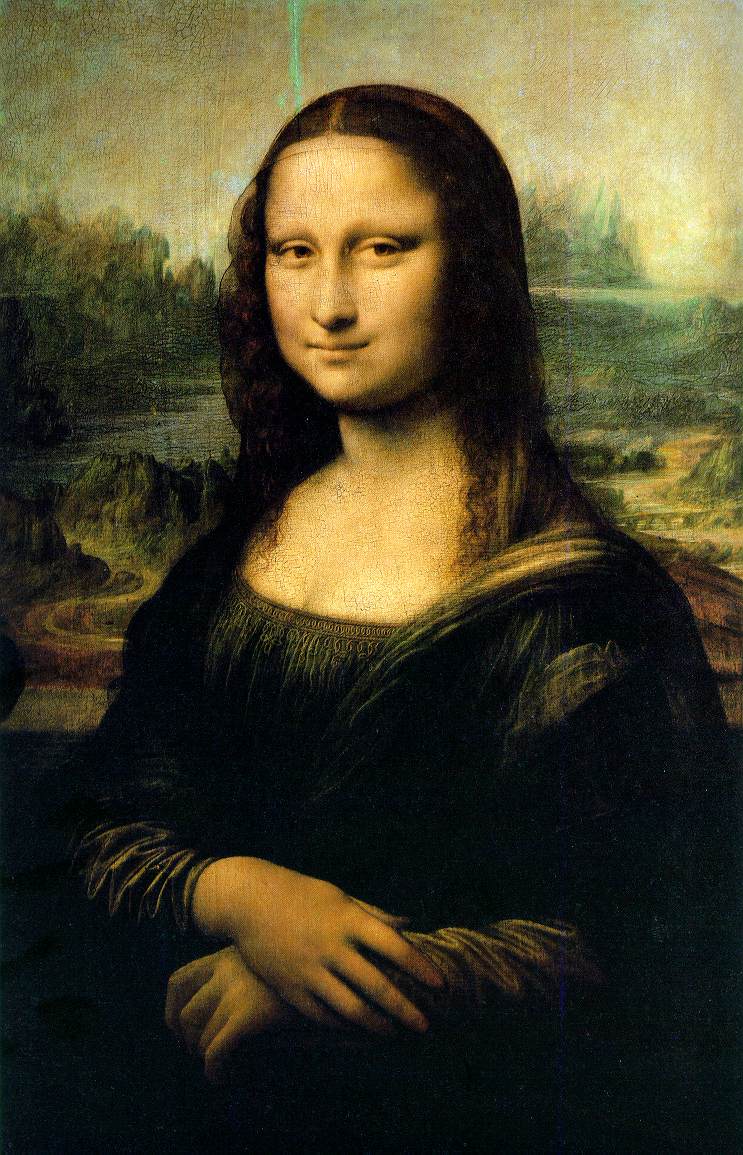
The Mona Lisa.

The Mona Lisa is the most famous painting/portrait in the world today. Historians think this because of the theft that occurred in the early 20th century. It took investigators and detectives 2 years to search for the painting.  However it wasn’t until November 1913 where an Italian art dealer Alfredo Geri received a letter from a person calling himself Leonardo. The letter stated that the Mina Lisa was in Florence and would be returned for a ransom but when Perugia (the alleged Leonardo) attempted to receive the ransom he was captured, with the painting unharmed.

            The Mona Lisa served as the main inspiration for occidental portrait painting. (PBS) There are several techniques Da Vinci uses one of which is the sfumato, which means vanished or evaporated. This technique is simple creating an “imperceptible transition between light and shade and sometimes with colours,  almost painting without boarders.  Something I found interesting when watching the Khan Academy video is the difference in the landscape from her head up and the from the neck below. The landscape below her neck seems like an inhabited landscape with a bridge and winding roads while the scenery at the top of the painting almost seems mysterious and space like. A quote I found gives a better description as to what he thinks it could be. “"The background may be a representation of the universe, with mountains, plains and rivers. Or possibly it is both reality and the world of dream. One could suppose that the landscape doesn't exist, that it is the young woman's own dream world." (Cuzin)

            Lastly, there is great controversy surrounding her smile however I think the bigger controversy, something relatively new is the notion that the muse for the Mona Lisa could be a man.  He goes by the name Gian Giacomo Caprotti,also known as Salai. He worked as Leonardo’s apprentice and they were rumored lovers.  Silvano Vinceti, a researcher who has closely studied the Mona Lisa using a state-of-the-art high magnification techniques claims he found the letter “S” in the models eyes which could be homage to Salai. But nothing is for certain. Even though we didn’t discuss the Mona Lisa It was a painting that I was very curious to learn more about it. I decided to blog about this because of the debate on weather or no the model was man, something i found very intregueing because i never questioned the gender of the Mona Lisa before. I personally cannot decide especially after I found this quote from an article from a professor at Milan’s Politecico University

“All Leonardo’s subjects look like each other because he represents an abstract ideal of beauty” (Bentley)

Sources:
http://www.history.com/this-day-in-history/theft-of-mona-lisa-is-discovered
http://www.pbs.org/treasuresoftheworld/mona_lisa/mlevel_1/m3technique.html
http://smarthistory.khanacademy.org/leonardo-mona-lisa.html
http://www.dailymail.co.uk/news/article-1352915/Mona-Lisa-model-man-Was-Leonardo-da-Vincis-male-apprentice-model.html

Botticelli: The Birth of Spring

This may be cheating a little because I talked about this piece in class but, you only live once, right?

The origins of this piece are disputed. Among these disputes is the original title of the piece, however, it is commonly referred to as "La Primavera" and "The Birth of Spring". From what I gathered, it is believed that this piece was probably created for the marriage of the cousin of Lorenzo d'Medici, Lorenzo di Pierfrancesco, around 1478. In class, I brought up the idea that art of this time has some story or history beyond the piece itself, meaning that often there was an event or commissioning that the piece was specifically made for. In this case, it was to create a bond between the Medici and the Appiano, a wealthy family with ties to the mining business- of which Lorenzo d'Medici sought after.

La Primavera: Botticelli
c. 1478
The allegory of this painting, like most of its aspects, is also disputed among scholars. However, the commonly corroborated analysis is the one that I shared in class, that this painting depicts an allegory of marriage. What's interesting about this piece is that it depicts a pagan scene- full of Roman and Greek figures of mythology, but is set up very much like in ecclesiastical depiction of Mary. This painting embodies the spirit of the Renaissance in that Botticelli is bringing back to life the stories and figures of antiquity, while at the same time placing them in a relevent sacred context. If you notice, the figures are parted just so in order to make Venus the subject of your eye. Also, Botticelli has parted the branches behind her in a manner that gives her almost a heavenly glow or a halo- similar to what you would see in a depiction of Mary. As I mentioned in class, this depiction of Venus is drastically more prude than her typical sensual, nude poses. Here, she represents balance between wild and tame love and takes on a much more "motherly" Mary-esque role.

Refresher: the pagan characters that are represented are (from right); Zepherus, a wind god, Chloris, a nymph who then turns into Flora, goddess of Spring, then Venus, goddess of love, Cupid (above Venus), Venus' mischevious son, the Three Graces, representing the feminine virtues of  Chastity, Virtue and Love and Mercury, messenger of the gods. They tell the story of the trials and tribulations of love from Zephyrus raping and happily marrying Chloris/Flora to the three graces and Mercury wildly basking in their unclaimed, raw desire.

Do you think that it was Botticelli's intention to reference the Madonna in this piece?

Sources:
Harris, Beth, and Steve Zucker. Botticelli's Primavera. video. SmarthistoryWeb. 19 Sep 2013.              <http://smarthistory.khanacademy.org/botticelli-primavera.html?                                                  searched=primavera&highlight=ajaxSearch_highlight ajaxSearch_highlight1>.
Garcia-Fenech, Giovanni. "Spring Mysteries:Botticelli's Primavera." Artstor. N.p., 20 03 2013.            Web. 19 Sep. 2013. <http://artstor.wordpress.com/2013/03/20/spring-mysteries-botticellis-            primavera/>.
http://www.uffizi.org/artworks/la-primavera-allegory-of-spring-by-sandro-botticelli/  
Two of a Kind
                   No you’re not seeing double, Leonardo Da Vinci actually painted two paints almost identical to each other. Rumor has it that he was promised a bonus if he finished the first version of the oil painting, but he was not happy with the bonus so he sold it to someone else. Then he had to recreate a second painting for the original buyer.

                   Normally, Mary is depicted as the queen of heaven. However, in this painting the Virgin Mary   on the ground, this type of representation is called Madonna of humility.

                   In typical Renaissance fashion Da Vinci puts a lot of detail into the background of the painting, to give it more of a 3-D effect.
                  
.                  and here is an interesting video about the paints….


  Sources:

Florence Baptistery


                The Florence Baptistery, also known as the Baptistery of Saint John, is dedicated to John the Baptist. Hence the second name. It was built between 1059 and 1128, in Tuscan Romanesque style. The style -though never getting very popular- influenced many famous architects of the time, including Filippo Brunelleschi. The Baptistery is designed in the shape of an octagon, the number eight being a symbol of regeneration in Christianity, standing for the six days of creation, the Day of Rest, and a day of re-creation through the Sacrament of Baptism.
 
                 The Baptistery hosts three bronze double doors; the south doors were done by Andrea Pisano, the north and east doors by Lorenzo Ghiberti. The east doors were later called by Michelangelo as the "Gates of Paradise". The Gates of Paradise contain ten separate pictures, each depicting a scene from the bible: Adam and Eve, Cain and Abel, the drunkenness of Noah, Abraham and Isaac, Esau and Jacob, Joseph sold into slavery, Moses and the ten commandments, the fall of Jericho, David and Goliath, and Solomon and the queen of Sheba.
Random fact that I'm to tired to fit in: Dante Alighieri was baptized here, along with many members of the Medici family.


The Fountain of Neptune

Bartolomeo Ammanati sculpted the Fountain of Neptune for the wedding of Francesco de' Medici and Giovanna d'Austria in 1565. However, the fountain was not completed until 1570 and  not unveiled until 1575. The Web Gallery of Art claims that the statue itself was an allusion to Cosimo de Medici's ambitious plan to bring a steady water supply to the city of Florence, as well as set up a port at Livorno. The fountain is located in the Piazza della Signoria in Florence. Years before the statue's construction, Ammanati,  Bartolommeo Bandinelli, and Benvenuto Cellini vied to construct a monument in the Piazza della Signoria. When Bartolommeo died Bandineli died, Ammanati won mostly thanks to the support of fellow artists Michael Angelo and Giorgio Vasari.


The Fountain of Neptune exemplifies renaissance style art through its emphasis on the human body, particularly the male body. The god Neptune stands centered, surrounded by smaller male demi gods, all of whom are sculpted with exceptional detail, with great emphasis on muscles and realistic representation. Similar to Donatello's David, which is a representation of the Greek god Mercury, Ammanati's choice of the god Neptune as the subject of his sculpture is an example of the classical era revival of the renaissance period.  Even the origin of the statue's creation symbolizes the Italian renaissance. Competition within renaissance era Italy helped to drive the emergence of culture within the Italian peninsula. The fact that the origin of the statue is rooted in competition epitomizes the values emerging in renaissance era Florence.

http://www.wga.hu/html_m/a/ammanati/neptune1.html