Sunday, February 14, 2016

The Righteous Defender

St Michael Raphael.jpg
              Raphael’s St. Michael originally painted at the request of Guidobaldo da Montefeltro duke of Urbino in 1504. The painting now resides in the Louvre. St. Michael who is an archangel; leader of God’s heavenly host. The painting institutes intrigue as the painting shows Saint Michael vanquishing a demon underfoot. Which is quite possible to be a parallel on how the Duke of Urbino at that time viewed himself as the Dukes of Urbino were renowned leaders who were constantly fighting on different sides of conflicts.

               The painting itself was the first time Raphael painted St. Michael, it is set in a very dark place similar to that of Dante’s Inferno vision of Hell. The lightest point of the painting being the shield of St. Michael. The shield being a protective device representative of how St. Michael is patron saint (protector) of those who fight. (soldiers and police officers) This shows of how St. Micheal protects his own. 

Thursday, February 11, 2016

Daydreams of Apocalypse - Botticelli's "Mystic Nativity"


Looking at artists and artifacts of the Renaissance period this week, I focused on Sandro Botticelli (1444-1510), a well-known painter of the period. Close to Lorenzo de Medici, Botticelli produced paintings both adherent to classical naturalism, yet particularly imaginative in execution (Zophy 90).  He was later influenced by the Dominican friar, Savonarola, who stressed an apocalyptic vision (pbs.org). Therefore, I chose to examine a later painting of Botticelli, one that likely reflects the intertwining concerns of apocalypse with the matured style of the Renaissance master.

“Mystic Nativity,” as it has been named, was painted by Botticelli in 1500, likely for a patron in Florence (nationalgallery.org). The image is first and foremost intriguing for the combined spiritual themes of both beginning (Jesus’s birth) and end (Revelations). The painting maintains Renaissance conventions of style- the symmetrical nature of figures and landscape, the emotive facial expressions of the figures, an overall naturalistic portrayal and a classical approach to nature/beauty.  In the painting, Mary appears as the central figure, kneeled over Jesus, while Joseph is more secondary, even turned away from the viewer’s perspective. The angels located near the earth almost appear as interlopers within the scene, interspersed amongst those who have come to visit the baby Jesus. Three angels perch on the roof, while the large rip or opening in the sky appears both contradictorily peaceful and looming at once. Additionally, the cave-like rock surrounding the small hut could be indicative of Jesus’s resurrection as well. Moreover, demons crawl in the very foreground where the darkest spots (light-wise) lurk in the painting. Consequentially, Botticelli may be rendering time as circuitous, rather than straightforward. On the other hand, the painter may have felt the forthcoming apocalypse to be an immediate danger, narrowing the timeframe from Jesus’s birth to the end of the world. Either or, the painting holds some chaotic urgency, even if remaining true to the stylistic importance of nature and order. In effect, the painting feels more questioning than frightening, blurring lines of reality even in a naturalistic style. Therefore, the painting lends a crucial understanding of the Renaissance period itself: the desire for order, for a rebirth of classicism, for perfection in figure, expression- all relate to underlying reactions to a somewhat chaotic, changing Renaissance world, one that sometimes resulted in beautiful manifestations of fear.


Sources:
Zophy, Jonathan W. A Short History of Renaissance and Reformation Europe. Pearson Prentice Hall, 2009.


Sunday, February 7, 2016

On The Last Day

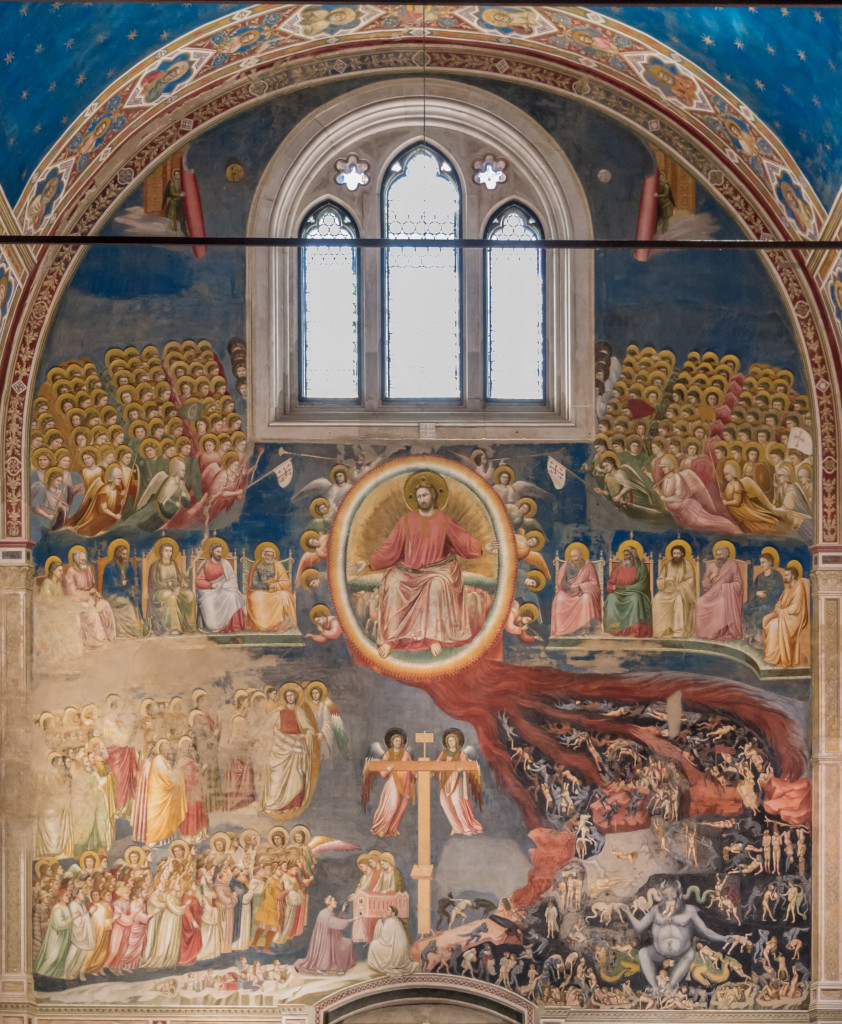
The Last Judgement by Giotto
Giotto: The Last JudgementThis incredible painting completed by Giotto in 1305 inside the Arena Chapel. Which has the Jesus Christ in the center of the fresco, being the main focus of the work of art. On either side of Jesus Christ are the twelve disciples which form a barrier separating Heaven from all other worlds. The Heavenly host being above Jesus while Earth and Hell reside below Him. The painting shows that the only path to Heaven is through Him Yet failure in this regard to meet the requirements to enter Heaven result in eternal damnation in hell which is on the other side of the cross. Hell is depicted in this fresco as eternal suffering and the people there are trying to seek reconciliation as they are seen attempting to reach out to Jesus.
               This shows how in this period artists were still centered around the church and religion yet were beginning to utilize a more life-like approach to depicting events. Also, along with that, is the fact that a Church could be built of such magnitude which demonstrates the wealth of the region at that point in time. Allowing the peasants of the time period to visualize what was taught to them at Mass, potentially allowing for a greater understanding of the prophecies of what is to come. 

Monday, February 1, 2016

The Wounds of Christ

As a part of his Saints-life St. Francis was said to have received the Stigmata, or the wounds of Christ. The wounds of Christ included the piercings in the wrists (or hands) and ankle, as well as a wound in the side of the abdomen from where Jesus was stabbed. It was said that these wounds were a gift from God to show that Francis had lived his life in a way that imitated Christ.

It is important to note that while St. Francis was referred to as another Christ, he was not thought of as equal to or instead of Christ. The idea that Christ had been perfect from birth and that St. Francis had merely been perfect from conversion shows a necessary distinction between a nearly perfect man and a perfect divine man. The gift from God is captured in this painting by the artist Giotto.


One thing to consider about this painting is the halo around St. Francis' head, denoting his piety. Another is the glory of the seraphim which humbles St. Francis and brings him to his knees, but St. Francis does not fall down and worship which keeps with Christian tradition. In the Bible, when Angels appeared to humans they would fall down and worship and the Angel would tell the humans not to worship them. St. Francis is merely kneeling in submission (and probably pain), rather then worship. I believe this speaks to St. Francis character even after being recognized for exemplary character.  

Sunday, January 31, 2016

The Tower of Italy

Giotto is best known for his work with paintings; however what some people do not know is that Giotto was also a successful architect as well. One of his architecture designs is not only a perfect example of 14th century Gothic style architecture, but is also one of the main monuments at the Piazza del Duomo in Florence Italy. This Gothic design is named simply Giotto’s Bell Tower. This Bell Tower was built for more looks than actual purpose in general. It was designed and created beside the Florence Cathedral, and incorporates the same type of marble that the Cathedral itself uses.

The construction of the Giotto Bell Tower started in the 14th century (1334) and finished production in 1359. An interesting to note is that Giotto died before the Bell Tower was finished. In fact the Bell Tower was only around the quarter of the way built before Giotto passed away. Giotto was succeeded by a man named Andrea Pisano who continued working on the Bell Tower using Giotto’s original designs, but also added his own personal artistic design as well. The Bell Tower was eventually finished being constructed in 1359 by Francesco Talenti who like Pisano incorporated his own design into Giotto’s original architectural design of the tower. Over all Giotto was the original architect of the Bell Tower, and his designs were the basis of which was used to create the Gothic masterpiece that is standing today.


Sources:


Let her go in a fresco


Giotto (1266-1337) was an early renaissance artist who flourished in the artistic style of fresco painting. This style of painting had the artist put their work directly onto the moist plaster by using pigments ground in water so that the paint would be apart of the wall itself.(Zophy 88) This was a very difficult technique that Giotto mastered. Using this technique, he helped revolutionize the artistic era of the early renaissance. Giotto’s platform which he painted on helped him get recognized, but his artistic ability is what helped him stand out from the rest of the artists of the time. Giotto wanted to make sure he grabbed the viewers attention and make them feel what the figures in the painting felt. This was done by giving nearly every one of the subjects an emotion that helped show the severity of the event. An example of this can be seen in Giotto’s fresco painting Death of the Virgin. In this fresco painting the virgin Mary is lying in her death bed while she is accompanied by her friends, family, and angles.


This painting embodies Giotto’s style to a tee with couple of interesting nuances seen within it. Giotto’s personal touch on his paintings is to show emotion with all figures. The grief seen on the faces of those witnessing the death of Mary is very noticeable. From the family to the angels, all show sorrow. One thing that is peculiar about this painting is that there is a significant number of angels present. At this point in time, woman were looked down upon, since Eve led Adam astray and caused the fall of man. Therefore, all woman were viewed as evil. With this in mind, this painting contained more angels than any other painting of its time which shows that Giotto realizes the significance of the event he is portraying. This can be related back to class discussions because Mary is experiencing the final sacrament of a catholic, the anointing of the sick. 

The Crucifixion

Giotto, early Renaissance master, combined naturalism and emotion to connect the viewer to the scene.  Found in the Arena Chapel of Padua, Giotto’s Crucifixion embodies these principles.  In this fresco, Jesus is positioned in the center, hung on a cross above a skull, which signifies that this is Golgotha.  On his left, soldiers are fighting over who gets to keep Christ’s clothes, while on his right, followers of Christ weep.  In this fresco, Giotto breaks away from the medieval style of painting, where subjects are stiff and stylized, with little dimension.  Instead, the figures in this piece stand in a variety of posed and have been painted with much more dimension.  Christ’s body is gaunt, with bones showing, and his hair is damp with sweat. Those gathered around do not stand side by side, but rather in groups, with glimpses of more people behind them, giving a sense of perspective.  The naturalistic method used by Giotto creates a much more life-like image; the viewer could feel like they were watching the crucifixion.


The emotion that Giotto renders in the scene also connects the viewer to the image.  St. Peter looks disappointedly at the bickering Roman soldiers.  All of Christ’s followers and the angels wear expressions of sorrow.  Jesus’s mother swoons in grief as she turns her head away from her son’s lifeless body.  Mary Magdalene expresses her grief passionately as she falls to her knees and weeps over Jesus’s bloody feet.  Giotto was inspired by the mendicant orders cropping up in his time.  The mendicant orders, especially the Franciscans, preached an emotional, energetic sort of spirituality; one should feel the pain of Christ’s suffering and the joy of knowing God.  Giotto’s aim in this fresco is to make the viewers feel the same as those in the painting.  The naturalistic view lets the viewer to feel as though they are in the painting, and the emotions evoke the grief and sorrow the followers would have felt, allowing the viewer to understand and feel the suffering of Christ's Crucifixion.  

Source:

The Evolution of Art as shown in the Ognissanti Madonna


The Ognissanti Madonna or Madonna in Maesta  was a work of art painted by Giotto di Bondone (1267-1337) for the Church of Ognissanti in Florence, Italy. This altarpiece which was 128 inches high and 80 inches wide would have sat behind the altar of the church where all parishioners would have easily seen it during mass and any visitor to the church would have had a easy view of this masterpiece upon entering the church. This painting indicates the Virgin Mary sitting on a throne while holding Jesus as a baby, all while angels kneel before them and people observe from the sides.

Painted in 1310 the Ognissanti Madonna not feature all of the three dimensionality of many of Giotto di Bondone's later works, with several of the onlookers appearing to be quite flat as they look upon the throne. However the painting does break with previous styles as all the characters in the painting are not looking directly forward and even Jesus and the Virgin Mary who are facing forward are seated at angles. Another partial break from earlier artistic styles is the possible representation of movement in the painting with the way baby Jesus has his hand lifted as if to indicate something or grab at his mother which is in contrast to all the other figures in the painting who do not appear to be in the middle of movement. The coloring chosen in the Ognissanti Madonna is interesting to note as well with a heavy emphasis on the reds and yellows which are used in such a way as to not appear harsh. In contrast to the rest of the painting the Virgin Mary is garbed in blue as she usually was when represented in images. The color blue at the time represented royalty and power and was the traditional color to paint the Virgin Mary. This aesthetic choice very much links the Ognissanti Madonna to earlier styles of painting and traditional thought on the subject matter. 

The Ognissanti Madonna has some very clear breaks from previous styles of painting from the angles that all of the characters are represented as being in to the suggestion of movement by Jesus. While at the same time the image has traditional elements showing like the color of the clothing of the Virgin Mary and some flatness in the background of the painting. This suggests that changes in art at the time were not an instantaneous but instead an evolving process that took time to develop.  
         

Ognissanti Madonna - Giotto (Tempera on wood, 325x204)

Sources
"Giotto" Virtual Uffuzi Gallery. 2016. https://www.virtualuffizi.com/giotto.html

"Ognissanti Madonna." Virtual Uffuzi Gallery. 2016. https://www.virtualuffizi.com/ognissanti-madonna.html
"Ognissanti Madonna (Madonna in Maesta) c. 1310" Giotto di Bondone The Complete Works. 2016. http://www.giottodibondone.org/Ognissanti-Madonna-(Madonna-in-Maesta)-c.-1310.html