Wednesday, May 4, 2016

A Witch's Burning Secret

During the reformation and post reformation, claims of witches living amongst the people of Europe became very frequent. Accusations that certain people, mostly women, were witches and housed the devil himself within them. In 1515 outbreaks of witch hysteria rained over Geneva, Switzerland as they accused and burned over 500 people at the stake. Just nine years later in Como, Italy, another 1000 people were executed under accusations of witchcraft. The only thing necessary for an execution of a "witch" was someone simply saying "He/She is a witch!" and they were then taken to trial. During these "trials" a witch would be found guilty of witchcraft with practically no way of escaping the accusation. Since witches house the devil they are known to lie. In this case anything they say is a lie unless they admit to being a witch of course. Even in this scenario they will be found guilty and executed. All of this chaos stems off of paranoia of the catholic church and the protestants.

The following piece is called 'The Examination of a Witch' by Matteson. Although this painting is from 1853 it holds the same value of those during the European witch trials. In the painting, the woman is being deemed a witch due to body markings that the town has seen. In this the presumed judge is examining these markings as others in the scene are fainting because of the disbelief that they are in the presence of a "witch". The woman's expression is that of a person who knows their fate. Being executed in a way only fit for a witch.

http://www.wsc.mass.edu/mhj/pdfs/TEACHING%20RESOURCES%20Teaching%20the%20Salem%20Witch%20Trials.pdf
http://law2.umkc.edu/faculty/projects/ftrials/salem/witchhistory.html

Three Decades of Divinity


The thirty years war began in 1618 and lasted until 1648. This war began with the holy Roman Empire attempting to "curtail certain religious privileges enjoyed by his subjects".. This sparked an uprising among the protestantsThe protestants then turned to some of the most powerful and well known protestant states in Great Britain, Denmark, and the Dutch Republic. In order to counter them other forces were brought into the picture such as the German catholics, Spain, and the papacy by the Roman Empire. After thirty years of fighting and many lives lost, the war ended at the Battle of Prague in 1648.

Through this long time span, life did not seize, and since life did not seize, art continued to be made. There were many pieces created regarding the war as it was a very volatile time period. A piece  called 'Rocroi, the last tercio' by Augusto Ferrer Dalmau depicted as seen by many as the turning point of this war as it showed that the perceived invincibility of the Spanish was false. The Spanish army was slaughtered by the French. In this piece, it is shown that many of the Spanish lay dead in front of a large amount of French soldiers realigning. Dalmau does not leave any room for imagination as he made this piece very graphic in many manors from dead horses, dead men, and how could one leave pools of blood from the image. A statement is made from this piece giving the viewer no choice but to know who won this battle.
http://www.history.com/topics/thirty-years-war


Monday, May 2, 2016

The Lion of the North

Attributed to Jacob Hoefnagel - Gustavus Adolphus, King of Sweden 1611-1632 - Google Art Project.jpgKing Gustav II Adolf of Sweden was one of the most power people in Europe at the time of the Thirty Years War. He led Sweden which up until this time had been seen as a lesser power. Under his leadership Sweden became the most powerful protestant state and would prevent the destruction of the Protestant League during the 30 Years War. Swedish involvement in this critical religious war that also led to dissolution what was left the Holy Roman Empire was a pivotal moment that completely changed the momentum of the war. Yet Gustav’s impact and progress, as a commander on the battlefield with no equals, during the war would find itself-undone when the King of Sweden was slain on the field of battle in Leipzig. The protestants would hold on and survive the war to negotiate the peace of Westphalia in 1648. Peace between the different denominations of Christianity would largely remain as both sides no turned to witch hunts to satisfy their taste for blood.

Reformation & Religious Tolerance?

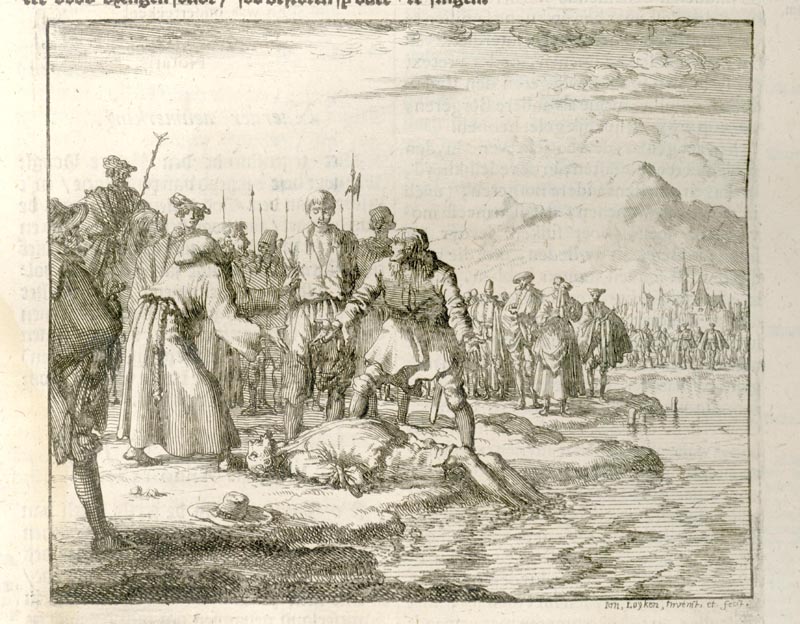
Upon reading the New York Times review of Benjamin Kaplan’s book, Divided by Faith, I gravitate towards the description that “Kaplan maintains that religious toleration declined from around 1550 to 1750.” (Steinfels). This argument for the decrease in religious tolerance during the period appears supported by events of the period, like, for example, the pockets of witch-hunting. Clearly, the Reformation did not necessarily promote open acceptance of all different reform movements that sprung from the period, if it did offer a Protestant alternative to the Catholic Church. One example of decreased religious toleration manifests in the experiences of the Anabaptists of the period, who were “arrested, burned at the stake, and sometimes symbolically punished by drowning” (Zophy 207).


Here, I utilize a woodcut to illustrate the persecution of the Anabaptists. Granted, this particular woodcut comes from “Martyrs Mirror,” a seventeenth-century collection of illustrations by Jan Luyken. Therefore, the art piece is subject to the influence of historical hindsight/revision itself. The specific engraving I chose depicts the drowning of Heinrich Summer and Jakob Mandel in 1582, both of whom were Anabaptists. The illustration naturally draws focus to the anguish of the man who has been subjected to the drowning. The figure above him actually seems to be questioning/displaying anger over the death, hands spread out in a gesture motioning to the plight of the man (Summer or Mandel presumably). Accurately, there are many onlookers- persecution during the Reformation period was intended to be public. The castle in the background and a sort of antiquated feel to the portrait (even for the 1500s) may hint at the feudal system that organized society primarily in the medieval period. In this way, the artist seems to separate his time period from even that of just a century previous. In general, the woodcut demonstrates the ways in which the Reformation was as much a challenge of older structures of religion/society as it was a reinforcement of order/religion/power structures in an intense or instigative manner.


Sources:

Steinfels, Peter. "A Revisionist Historian Looks at Religious Toleration." New York Times, Nov. 24, 2007. Print.

On the artist- http://www.geheugenvannederland.nl/?/en/collecties/jan_en_casper_luyken/jan_luyken

On the Martyrs Mirror- https://kauffman.bethelks.edu/martyrs/creation.html

Image- https://mla.bethelks.edu/holdings/scans/martyrsmirror/

He's Out for the Count- "The Bewitched Groom"


As we have studied, the Reformation occurred contemporaneously with some major pockets of witch-hunting in German regions and elsewhere. The atmosphere of religious fervor, growing bureaucracy, and the religious upheavals/resulting societal expectations contributed to the appearance of witch-hunts. However, there were many factors involved and I chose this particular woodcut to examine the witch-hunts in relation to the influence of the Reformation. Entitled “The Bewitched Groom,” this woodcut was produced by Hans Baldung Grien in 1544.

Although not necessarily focused on witches, the woodcut is telling in a number of ways. For one, the witch-like figure leaning in by the windowsill appears old and is waving a sort of broom or possibly plant stalk in a violent manner. Secondly, the male figure is drawn at such an angle as to emphasize male sexuality, even as he has been rendered unconscious or at the least, knocked down. Importantly, his tools lay loosely by him, un-useful in his bewitched state. Moreover, the horse stands with his rear towards the main figure, which suggests the inverted or unnaturalness of the scene overall. Reformation ideals called for the man to be the powerful and moral leader of the house, while women were expected to be obedient wives and mothers. This woodcut displays the fear of non-conformity to such order. As described, the woman’s age, appearance, and action make her unsuitable for female domesticity. The male is bewitched and again, not able to carry out his duties. Overall, this demonstrates how the Reformation, rather than a free flow of religious debate, became a rigid sort of structuring mechanism for society, in which notions of gender influenced the occurrence of witch-hunts.  


For a clearer image/info- http://www.metmuseum.org/art/collection/search/336238

Thursday, April 28, 2016

The Power of a Portrait

Queen Elizabeth I is widely regarded as one of England's greatest monarchs.  One of her many strengths was an understanding of the importance of public image.  Her portraits were carefully crafted and included symbols to convey power and majesty.  The Rainbow Portrait, painted in 1600 by Isaac Oliver, exemplifies the use of images to illustrate the Queen's good qualities.  The cloak that Elizabeth is wearing in the portrait is embroidered with eyes and ears, signifying that she can hear and see everything.  Her intricate headdress is decorated with pearls and rubies, and holds up her royal crown.  The pearls are meant to represent her virginity, while the crown illustrates her royal status.  On her left sleeve is a jeweled serpent with heart-shaped ruby in its mouth; the snake symbolizes wisdom and the ruby represents the Queen's heart.  The snake has caught the heart, meaning that the Queen's wisdom restrains her emotions.  Above the snake is a celestial sphere, which also signifies wisdom and the Queen's power over nature.  Elizabeth holds a rainbow in her right hand with the latin phrase 'Non sine sole iris' (No rainbow without the sun) inscribed above.  The rainbow represents peace and prosperity, while the inscription tells the audience that the Queen and her wisdom brings the peace and prosperity.  Though Elizabeth was actually in her sixties when this portrait was painted, she is depicted as young and beautiful.  This portrait was carefully thought out to present a wise and powerful monarch.

Sources:
http://www.marileecody.com/eliz1-images.html

Huguenots: Where are They Now

French Huguenots were a part of the reformed reformation process and mainly located in within France. The Huguenots like the Cathars, who preceded them, had to fight for their beliefs against the French Catholics . Yet unlike the Cathars the French Huguenots successfully defended their faith and were not exterminated. Under the edict of Nantes the Huguenots were protected until it was repealed in 1685. The result would be a massive diaspora of hundreds of thousands French citizens to more accepting protestant nations such as Great Britain and Germanic Countries. Great Britain which allowed much more religious freedom in her colonies is probably why so many Huguenots who retain their denominations traditions are currently residing in Australia. Though their numbers are vastly smaller than at their height which was around 2 million French believers. Though many assimilated to the cultures of the countries they fled to. While not all Huguenots fled France and a couple Huguenot communities remain in southern France. As in 1787 protestants such as the Huguenots finally were accepted and considered equal citizens under law. Also there is a Huguenot society in America that accepts applicants who can prove Huguenot heritage or is sponsored by a current member. 

Monday, April 25, 2016

It's in the eyes- Artwork of St. Teresa of Avila

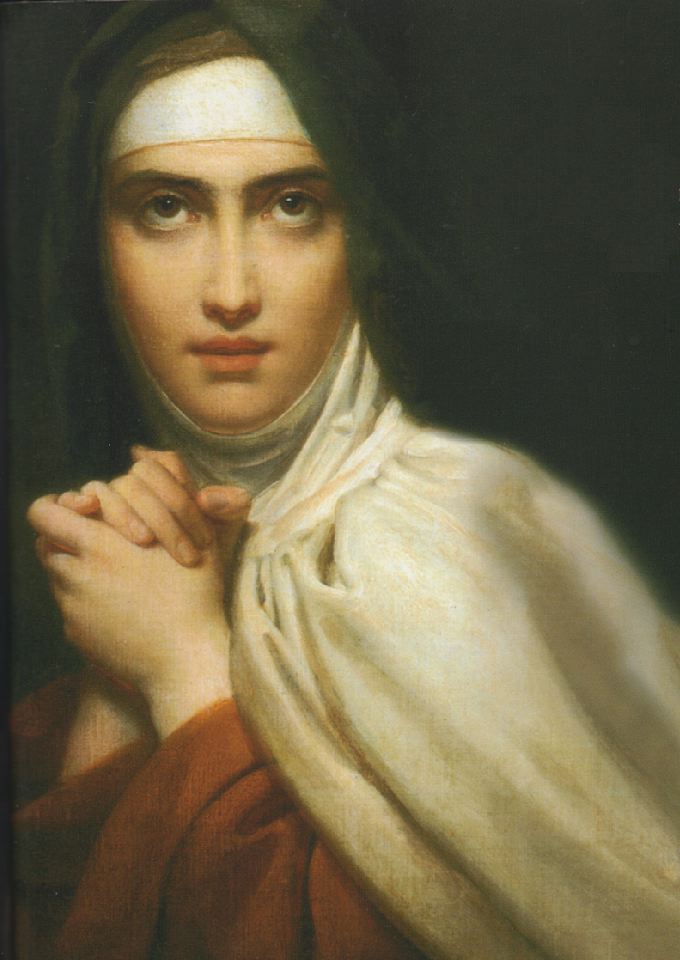
In accordance with our study of the Counter Reformation, I will look at another figure of the period – St. Teresa of Avila – through the lens of two different works of art. Teresa of Avila (1515-1582) is best known for her mysticism, writings, and leadership in the Carmelite order in Spain.  During her lifetime, she remained persistent in the growth of a reform-minded Carmelite order, as well as wrote works such as Way of Perfection and her Autobiography (Zophy 261-262). I desired to compare two works focused on St. Teresa of Avila in order to demonstrate both her own legacy and that of the Counter Reformation.


The first work is Bernini’s infamous sculpture, The Ecstasy of St. Teresa. Sculpted in the years 1647-1652, the work stands as a testimony to Teresa of Avila’s distinct mysticism, as it depicts her in the midst of a religious vision. As the viewer can see, the sculpture retains all the drama of the Baroque period whilst rendering the saint as overwhelmingly beholden to her spiritual vision. Moreover, the facial expressions of both Teresa and the other figure evoke emotion and vivid experience. The multiple folds of Teresa’s garb add further spectacle to the scene. In comparison, the second work, Baron Francois Gerard’s St. Teresa, is altogether different, but this naturally stems from its later time frame (early 19th century) and thus, Romantic style. The portrait simply gives a modest Teresa, with eyes that angled upward convey a subtle link to mysticism, but moreover, convey a blend of piety and mystery. Gerard gives an ideal Teresa, quiet but impactful in beauty and mystery, a spiritual figure from a faraway, lost place (hence approximately two centuries in separation between the portrait and her death).  Bernini equally moves away from reality, but in a way that still seems evocative of the mysticism central to St. Teresa’s character and even the criticism she faced. The works are in truth mostly contrasting depictions of St. Teresa, but they both persist in demonstrating the historical impact of reformers from the period, who tend to appear as stabilizers not defectors after their lifetimes.


teresa_avila_gerard

Sources:

http://www.metmuseum.org/toah/hd/bern/hd_bern.htm
http://www.wga.hu/html_m/g/gerard/7theresa.html

Images:
http://www.artble.com/imgs/d/a/5/431705/the_ecstasy_of_saint_theresa.jpg
https://fraangelicoinstitute.com/2012/10/15/st-teresa-of-avila-on-love/teresa_avila_gerard/